
Short answer: The body area sets the protocol on an EMS Body Slimming Machine, and the handpiece you pick decides where the field lands and how the block runs. Four areas pay the bills in most rooms. Abs. Arms. Glutes. Thighs.
We build these machines. We also sit with new owners through their first month of trading.
The console is never the hard part. The menu is.
Same console. Four different plans.
Abs Come First
Most rooms open with the abdomen. Clients name it before you ask.
Arms come second, usually as an add-on. Someone books a core block, then asks about a sleeve.
Glutes arrive later. Thighs later still. Both eat more clock.
Reading The Goal
Clients describe areas. They rarely describe protocols.
“Flatter here.” A hand on the waist. That’s the abdominal pair.
“Tighter arms before a wedding.” Two small handpieces. Short blocks. A cadence that fits a date.
“My jeans.” Usually glutes and outer thighs together.
A point at the mirror becomes a placement. Write both areas on the card before the first session.
Vague goals stay vague. A named area and a named cadence convert better than a package leaflet.
Two Ways To Do Abs
The abdomen isn’t one setting. It’s two.
The standard abdominal pair suits a client chasing definition across the upper and lower core. Two handpieces. One pass. Symmetrical placement.
The large abdominal handpiece suits a wider torso, or a goal that runs across the whole waistline. One handpiece covers the field. No gap in the middle.
Look at the torso before you choose. Two smaller handpieces on a narrow waist beat one wide handpiece sliding off the ribs.
Ask where the client wants the change. Point at the mirror. That answer picks the placement.
Get the split right and the abdominal service is easy to describe. Get it wrong and the client leaves unsure what they bought.
Arms Run Shorter
Arms change the most. Small muscles. Lower tolerance.
“That’s sharp.” We hear it on arms first.
The two small handpieces exist for this work. Upper arm or forearm.
A wide handpiece leaks on a narrow limb. It stings.
Climb slower here than on the abdomen. Expect the contraction sooner. Less tissue sits between coil and muscle.
Arm blocks run short. Fifteen minutes fits beside a longer abdominal booking.
That’s a scheduling advantage. Not a compromise.
Most arm work sells as an upgrade. Few clients book it alone.
Ten minutes on, then look at the skin. Red patches under a small handpiece settle faster than under a wide one.

Glutes Want Wide Contact
Glutes sit at the other end. Big muscle mass. Broad surface.
The large abdominal handpiece often travels there. A broad face holds contact better than a small one bridging a curve.
Placement matters more than intensity at the start. Lay it flat. Then climb.
Once the client settles, these areas take an assertive build. That’s where the output range earns its place.
Watch the tailbone. Bare skin, hard bed, one edge digging in. Reposition before the first minute.
“It’s buzzing on the left.” That usually means the handpiece lifted at one edge. Press it back and carry on.
Two placements often run back to back. Same channel, same level.
Sessions run long. Book them that way.
Thighs Split In Two
Thighs split front and outer. Two placements per leg, usually.
The outer sweep won’t share a handpiece with the front. So the clock stretches.
A thigh block runs longer than an abdominal one. Schedule it that way.
Watch the change of position. The handpiece has to stay put as the client rolls.
A shifted handpiece means a cold session down one side.
Clients pair thighs with another area. Build the booking around that, not against it.
Four Channels, Two Zones
Four independent channels turn one appointment into two zones.
Hold the abdominal setting on two channels. Run an arm or thigh block on the other two.
The appointment shortens. Neither area suffers.
That matters commercially. A client who likes one zone asks about a second.
Log the channel and the area it served. Next visit repeats instead of improvising.
Setup Between Areas
A two-zone visit needs a changeover. Budget it.
Swap the handpiece to the pair that area uses. Set the channel to that area’s level. Wipe the face you just used.
Practise the swap twice at launch. Fumbling in front of a client costs you the second zone.
Two zones on one visit is the single easiest upgrade in the room.
The Map On The Door
Write the handpiece map on a card. Tape it inside the cabinet door.
Channels one and two: the standard abdominal pair. Channel three: the large abdominal handpiece. Channel four: the small pair.
Staff swap channels between shifts. The card stops that.
A new operator reads the card, sets the handpieces, runs the block. No guesswork at the bedside.
Four Kinds Of Buyer
Different buyers want different shapes of offer.
A gym member buys a short block tied to a training cycle. A compact abdominal plan fits better than an open membership.
A med spa client buys a two-area plan on a set cadence. They pay for the appointment as much as the treatment.
A new studio needs the simplest thing. One entry service the staff can deliver on day one.
Hold the two-zone option back as the upgrade.
Segments overlap. A gym member becomes a med spa client after one good cycle.
Sell the shape of the plan, not a fixed package. Put the area and the cadence on the card.
Cadence, Not Counts
Sell a rhythm, not a number.
Weekly for the first stretch. Then fortnightly. Then a maintenance visit the client books themselves.
Write it as a range. Say it as a range. Individual responses vary, and a fixed count is a promise you can’t keep.
A client who hears a rhythm knows when to come back. A client who hears a number starts counting.
Numbers belong in your diary. Ranges belong in the consultation.
Pricing A Block
Pricing follows the clock, not a promise.
Set the entry around the shortest safe block for that area.
Add the extra time a combined visit takes. Nothing more.
State the cadence up front. No outcome attaches to the signature.
Discounting the entry to fill the diary teaches clients what the service is worth. That lesson is hard to unlearn.
A block that runs long every week is priced too low for the calendar it eats.
What you charge sits with you and your accountant. Not with us.
Nothing Promised
We don’t sell session counts. We don’t sell outcomes.
Individual responses vary. Whether someone is a candidate stays a clinical question, answered by your clinician under your local rules.
Some clients won’t be candidates. Pregnancy. A pacemaker. Metal inside the treatment zone. Certain medical conditions.
Unclear? Refer. Don’t book.
Note the decision in the file. Date and name.
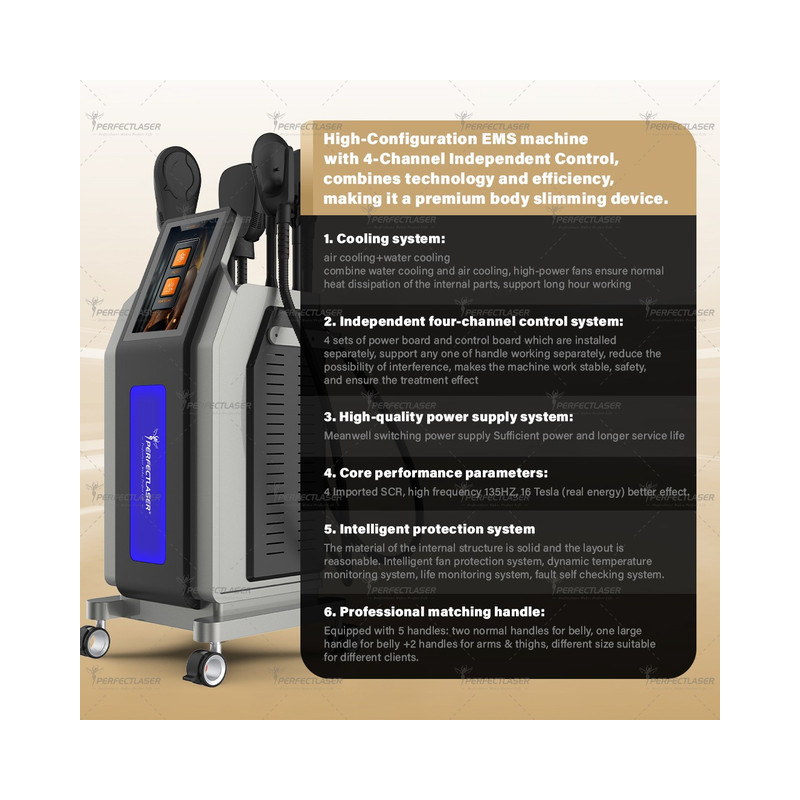
Our own sheet lists hardware, not promises. Two standard abdominal handpieces. One large abdominal handpiece. Two more shaped for the arms and thighs.
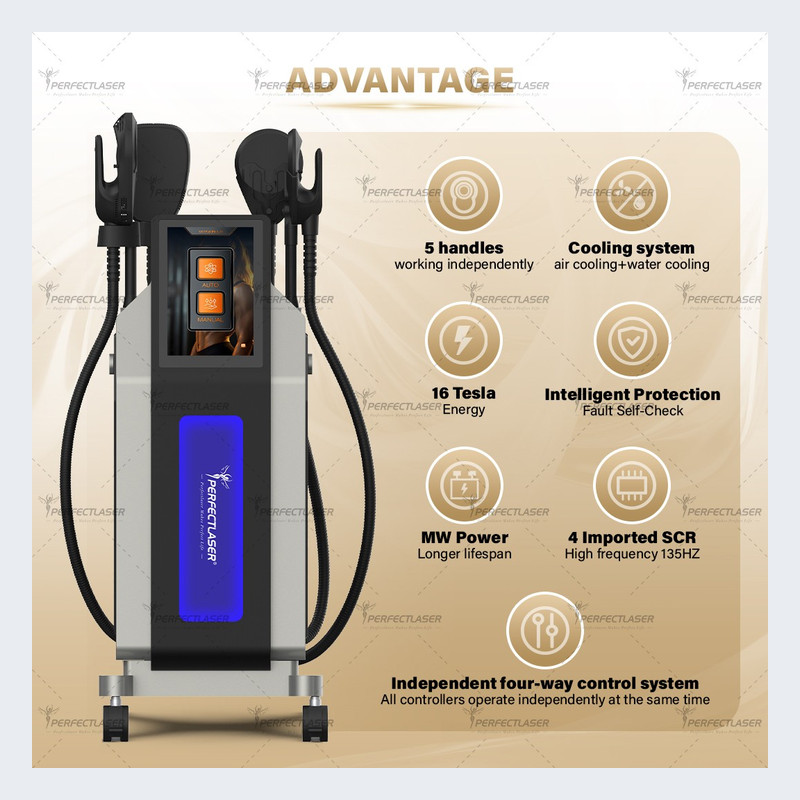
Four channels. A 15.6-inch screen. Auto and Manual modes. Air and water cooling.
That’s the machine. Everything else is your call.
Launch Week
Pick one area to launch. The abdomen, for most rooms.
Train two operators before the first booking, so a sick day doesn’t stop the diary.
First client on a conservative setting. Confirm the check-in answers again on the day.
Say what the session feels like and what it sounds like. Then give the client the word that stops it.
Log four fields per visit. Area, handpiece, channel, level reached. Twenty seconds.
The room runs late when changeover time is missing from the diary. Add it or lose your lunch.
A busy room soon knows which area pays. Rebuild the menu around it next quarter.
The Desk Script
“I want my stomach flatter.” That’s abdominal work.
“My arms, really.” Small handpieces, gentler build.
“My legs. My backside.” Wide handpiece, longer block.
Write those three replies on the booking screen. Staff read them under pressure.
Two sentences at the desk save a confused consultation later.
Tell the Perfektlaser team which areas you expect to sell most, and how your clients book. We match the handpiece set and the channel layout to that mix. Your menu should sit on hardware built for the areas that pay the bills.
 English
 Arabic
 Chinese
 Dutch
 French
 German
 Italian
 Portuguese
 Russian
 Spanish