
Short answer: Vetting an EMS Body Slimming Machine supplier means checking the plant, the certificate holder, the model scope, the warranty procedure and the contract clauses that survive a dispute. Documents beat promises. The strongest suppliers invite the awkward questions.
Buyers shortlisting Chinese suppliers often start with price. That’s the wrong order.
Price is easy to quote. It’s hard to verify.
Process is the opposite. It shows itself on a live call.
Before anyone argues about unit cost, settle three questions. Does the line exist? Does the paperwork point at the right company? Is the warranty a promise or a procedure?
We build these units and sit through these audits. Here’s the sequence we would run if we were buying.
Audit On Site
A supplier who can’t show the line isn’t a factory. It’s a sales office.
Ask for a live walkthrough. Not a photo set. Steer the camera yourself.
Watch where the unit is actually built. Not a showroom. Not a warehouse.
Four Stations
Look for four stations on that walkthrough.
Coil assembly comes first. Then the power and control bench.
Then the long-run aging rack. A finished unit runs there under load.
Finally the QC table. Every unit passes it before crating.
The 6000W module sits near the control board. The water loop meets the air ducting nearby.
Ask an operator to open a finished housing. Ask them to point at each part.
The pure copper coil joins ODU German-made tubing through knob-type connectors. That join is worth seeing.
Ask One Number
Close with one question. How many finished units clear QC each month?
Then ask which months are busiest.
That answer separates a plant that builds continuously from one that assembles to order.
Prepare the questions before the call. Then ask them in order.
Which entity holds the certificates? What does each one cover?
Which model was tested? When does each report expire?
Who signs off on QC before the crate closes?
Record the answers. A recording beats a memory.
Ask to see a unit run. Not a still photo of one.
Watch the channels fire one at a time. Watch the screen change mode.
Ask about the coil. Pure copper, or a substitute?
Ask about the tubing. ODU German-made, or a local copy?
Those two answers predict the first year of ownership.
What The Audit Proves
An audit proves a process exists. It doesn’t prove your unit will be perfect.
It raises the odds. It gives you a document trail when something fails.
That trail is the real product of a factory visit.
A live video audit suits most first orders. Set the route yourself.
See the actual build stations. Not a staged corner.
An in-person visit suits a large order. Or a new category for your market.
Either way, watch process. Not presentation.
Document Pack
A certificate is easy to obtain. It’s easy to misread too.
Ask for the business licence. Ask for a quality-system certificate.
Ask for the electrical and EMC test reports. Ask for the document your own market requires.
Then check the holder name. It must match the company on your invoice.
Scope Limits
Scope is where buyers stop reading too early.
A quality-system certificate proves a documented process. It doesn’t prove your model was tested.
An EMC report covers the sample submitted. Not every unit that leaves the line.
Match four things. Holder. Scope. Model. Expiry date.
Miss one and the paper proves nothing about your machine.
FDA And CE
For the United States, an FDA listing or 510(k) clearance describes a device and its intended use.
It doesn’t hand you a marketing claim. Read the cleared indication before you write any copy.
For the European Union, a CE declaration identifies the manufacturer and the standards applied.
Confirm it names this configuration. Not a sibling model.
RoHS covers restricted substances. It says nothing about clinical performance.
Warranty Structure
Warranty language drifts when nobody writes it down.
A workable warranty names the covered parts. It names the period for each.
It says who pays return freight. It sets a replacement timeline.
Keep that wording tied to the written contract. A verbal cover reads differently six months later.
Wear Parts
Wear points on an EMS platform are predictable.
Coils. Handpieces. The cooling pump and tubing. The touchscreen. The connectors.
Each one should have a stated position. Each one should have its own term.
Handpieces wear at a different rate from a control board. A blanket promise hides that.
Ask three practical questions. Does the cover travel with the machine to the clinic?
Is a failed handpiece exchanged complete, or repaired locally?
And what happens in month thirteen? The original term has lapsed. The end client is still calling.

Contract Clauses
Five clauses carry most of the risk.
The first freezes the specification. Not a “standard unit”. The exact build.
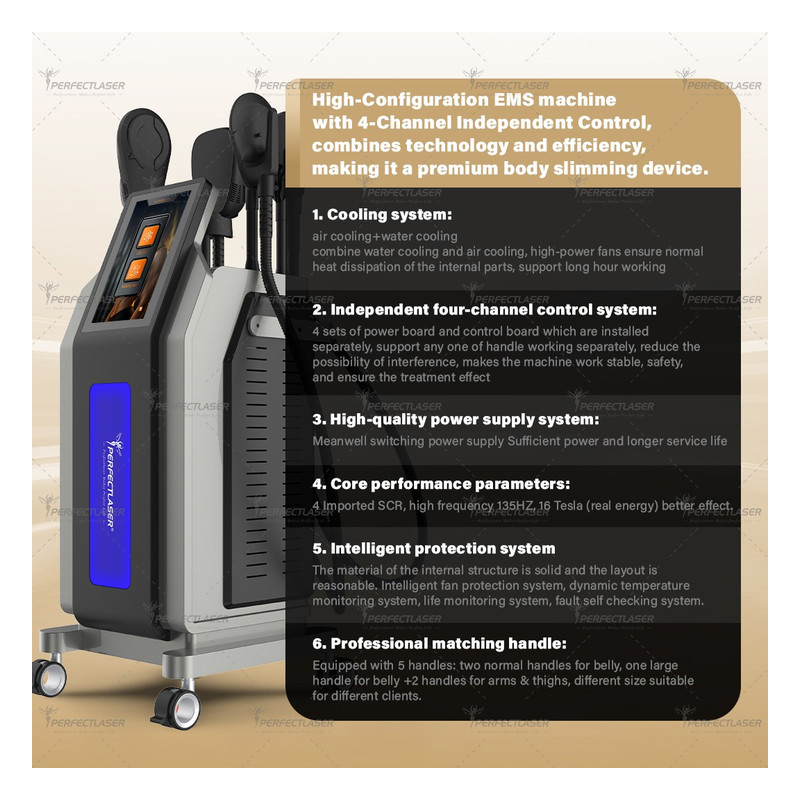
Write it out. The 6000W power section. The 1–135Hz band. The 16 Tesla field.
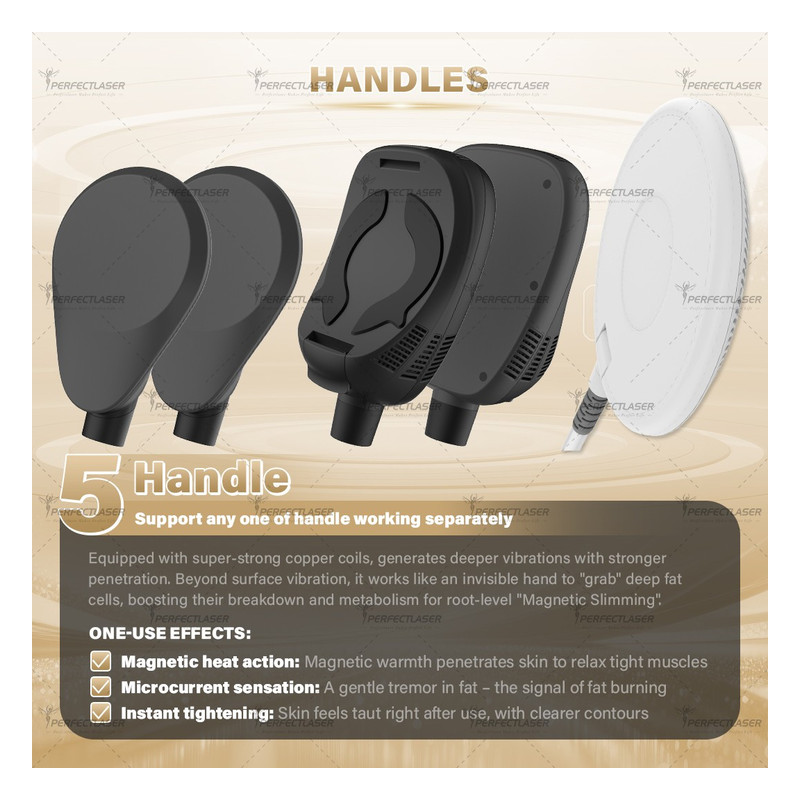
Five handpieces. Two standard abdominal. One large abdominal. Two for arms and thighs.
Four independent channels. Air plus water cooling. A 15.6-inch touchscreen with Auto and Manual modes.
Pure copper coils. ODU German-made tubing. Knob-type connectors. A metal plus ABS housing.
Packaging at 67*61*135cm and 111KG. Support for 100–120V and 200–240V at 50/60Hz.
The second clause defines an acceptance test. What gets checked before crating.
The third commits the supplier to a spare-parts window with named timelines.
The fourth sets the shipping term and who carries risk in transit.
The fifth names the governing law and the dispute venue.
That last clause matters more than buyers expect. The counterparty sits eight time zones away.
Red Flags
Watch for refusals first.
A supplier who won’t run a live audit has told you something.
So has one who won’t name the certificate holder. So has one who won’t put a warranty period in writing.
Quieter signals matter too. No serial-number tracking on finished units.
Eagerness to skip the acceptance test. A request to route payment to a personal account.
A specification sheet that changes between two emails.
None of these prove bad intent alone. Together they describe a seller optimising for the order.
Verifying Delivery
Photograph the crate on arrival. Photograph the housing. Photograph each handpiece.
Check the serial number against the documents. Then run the acceptance test in the contract.
Confirm the voltage variant first. Then confirm the handpiece count.
Those two items change most often without notice.
A first order tests the supplier as much as the hardware.
Buy one unit before you buy ten. Watch how the paperwork arrives.
Watch how fast a question gets answered. Watch what happens when something is wrong.
A supplier who is slow on one unit is slower on ten.
Spare Parts Window
Ask how long spare parts stay available. Get the number in writing.
Name the parts that matter. Coils. Handpieces. Pump. Tubing. Connectors.
A spare-parts window with timelines protects the second year.
Ask what happens after that window closes. Ask for the price list now.
Pay the company on the invoice. Not an individual.
Match the bank account name to the contract. Match it to the licence.
A payment routed to a personal account is a red flag on its own.
Keep every transfer receipt. They become your proof later.
Some answers end the conversation.
No live audit. No named certificate holder. No written warranty period.
No serial numbers on finished units. No acceptance test before crating.
Any one of those is a reason to slow down. Two is a reason to leave.
Ask for the minimum pack before any money moves.
The business licence. The quality-system certificate. The electrical and EMC reports.
The regulatory document for your market. A written warranty schedule.
Keep copies dated. Make the certificate holder match the invoicing entity.
If a supplier stalls on those, treat the stall as information.
Factory Or Trading Company
Compare the holder name on the certificate with the name on your proforma invoice.
Compare both with the address on the walkthrough video.
If they differ, ask which entity manufactures. Ask which one exports.
A trading company can be a good partner. You still need to know who is accountable for the build.
The Vetting Order
Run the sequence in a fixed order.
Confirm the plant is real. Confirm the certificates point at the right entity, product and date.
Confirm the warranty reads as a procedure. Then fix the contract clauses that decide a failed unit.
Price comparison belongs at the end. A cheap unit from an unverifiable supplier isn’t cheap.
Ask the Perfektlaser team for the audit walkthrough, the document pack and the written warranty terms. We build the platform described here and will take you through the certificate scopes and the spare-parts position line by line. Ask the awkward questions first. It’s cheaper for both sides.
 English
 Arabic
 Chinese
 Dutch
 French
 German
 Italian
 Portuguese
 Russian
 Spanish