
Short answer: quality control is the part of a laser purchase a buyer never sees, and it is the part that decides how the machine behaves in year two. The useful question is not whether a supplier says its manufacturing is rigorous, but what it can show: documented component selection, unit-level testing with recorded results, a traceable serial number, and a service route that produces feedback into the design.
Two machines can carry the same specification sheet and behave differently in a treatment room, because the sheet describes what the platform is designed to do rather than how consistently each unit achieves it. Buyers who understand that difference ask different questions, and the answers tell them more about a supplier than any brochure will. A Pico Laser Tattoo Removal Machine is an optical instrument with a high-energy power architecture — the UltraPico configuration specifies 350ps pulses at 1.67GW peak power, a 3000W system, and a wavelength set of 1064/532, 755 and 1320 standard with 585nm and 650nm available as options — so the assembly and testing discipline behind it has a direct relationship with how consistent the delivered output stays. This guide covers the stages where quality is decided, and the questions that reveal whether a process exists.

Why Manufacturing Discipline Is a Buying Criterion
The commercial argument is straightforward. A machine that holds its output requires less rework in the diary: settings stay comparable, sessions run to the planned length, and the operator’s records remain meaningful over time. A machine that drifts costs the room in ways that never appear on an invoice — longer sessions, rescheduled clients, and the slow loss of the consistency that repeat bookings depend on. Manufacturing discipline is what makes drift less likely, and it operates through a handful of visible mechanisms: components chosen against a specification rather than a price, assembly practices that protect optical surfaces, testing that verifies each unit rather than a sample, and records that allow a specific machine to be traced back through its build. None of those is exotic. What separates suppliers is whether any of them is documented well enough to be checked.
Design and Component Selection
Quality begins before assembly, in the choice of the parts whose behaviour the specification depends on. The pulse duration and peak power figures describe the performance of a picosecond optical and energy-delivery chain in which the tolerances of individual components matter, and a supplier’s documentation should be able to describe how those components are specified and sourced. The practical questions for a buyer are narrower than they sound: which components are rated for the machine’s operating conditions, how component changes are controlled once a model is in production, and whether the supplier can tell you what happens to the documentation and certification if a part is substituted. That last question matters especially for buyers in regulated markets, because a component change can affect the basis on which the equipment was certified. A supplier with a controlled change process can answer it; one without will answer a different question.

Assembly, Traceability and Records
On the production floor, three practices are worth asking about. The first is environmental discipline during optical assembly, since contamination on a coated surface or inside a sealed assembly is a defect that will not show until the machine is in service. The second is traceability: the ability to connect a finished machine’s serial number to its build record, the components installed in it and the tests it passed. Traceability is what makes a warranty conversation factual rather than argumentative, and it is what allows a supplier to act on a field failure by identifying which units share a suspect batch. The third is calibration documentation for each unit, recorded at the point of manufacture rather than reconstructed afterwards. A buyer can verify all three by asking for the build and test record for the machine being quoted — not for the model, for the unit.
What Unit-Level Testing Should Measure
Testing is the stage that converts a design into a claim, and it should be specific. For this class of equipment, the meaningful measurements are the delivered output against the commanded setting across the energy range the machine is documented to provide — 100–500mJ at 1–10Hz in this configuration — together with verification at each wavelength in the supplied set, checks on the pulse behaviour the specification describes, and confirmation that the handpiece and its connections deliver consistently. Environmental and electrical checks belong in the same record alongside the picosecond measurements: power-up and self-check routines, safety interlocks, and the interface behaviour on the 18.5-inch color screen that the operator will rely on daily. A buyer’s question is not whether testing happened but what was measured and where the results are kept, because a documented result is the only version that survives a change of staff at either company.
The Documentation Set and What It Proves
The documentation set is the visible output of the whole process, and for this platform it includes the FDA/RoHS/CE documentation together with the 2-year warranty terms. What a buyer should check is whether the documents name the exact model and configuration being supplied, because a certificate that describes a different configuration does not describe the machine in the crate. It is also worth confirming how documents are kept current — who is responsible for updating them, what notice accompanies a change, and how a buyer in another market obtains the version that applies to them. The documentation file serves three audiences after the sale: an inspector asking how the equipment is assured, an insurer assessing the risk, and a service engineer who needs to know what they are working on. A supplier whose file answers all three is demonstrating a process; one whose file is a folder of generic PDFs is demonstrating a marketing department.
Field Data: Service Records and Failure Reporting
The final stage of the loop is what happens after delivery, and it is the hardest to assess from outside — which is exactly why it is worth asking about. A supplier with a functioning quality system can describe how service events are recorded, how a recurring failure is identified across a fleet, and what changes as a result: a component substitution, a firmware adjustment, or a revision to the service schedule. Ask also how warranty claims are tracked, what the average resolution involves, and whether field feedback reaches the people who design and build the machine. The reason this matters to a buyer is practical rather than philosophical: a machine whose manufacturing process learns from the field holds its value longer, and a supplier that can describe the loop is a supplier that has one.
Questions That Reveal a Quality Process
The questions are simple enough to ask in a single email. Which components in the energy and optical path are specified, and how are substitutions controlled? Can you provide the build and test record for the unit you are quoting, keyed to its serial number? What is measured at unit level, across which settings, and where are the results kept? Do the certificates name the exact configuration being supplied? How are warranty claims recorded, and how does field feedback feed back into production? Listen less for reassuring adjectives than for the presence of records: a supplier who answers with documents has a process, and a supplier who answers with assurances has an intention. Neither answer is proof about any individual machine — but one of them can be checked.
| Stage | What good practice looks like | What to ask for |
|---|---|---|
| Component selection | Parts specified for the operating conditions | Substitution control process |
| Optical assembly | Environmental control and surface protection | Assembly procedure summary |
| Traceability | Serial number linked to build and component records | Build record for the quoted unit |
| Unit testing | Output measured across the documented range and wavelengths | Test record with settings and results |
| Documentation | Certificates naming the exact model and configuration | Current certificate file for the unit |
| Field feedback | Service events recorded and acted on | How claims are tracked and resolved |
أسئلة متكررة
1. How can I check a supplier’s manufacturing quality before buying?
Ask for the build and test record for the specific unit being quoted, the certificate file naming that configuration, and a description of how component substitutions are controlled. A supplier who answers with documents has a process you can inspect.
2. Does the certificate cover the exact machine I receive?
It should name the model and configuration supplied. Confirm this in writing before the order, because a document describing a different configuration does not describe the machine in your room, which matters for insurers and inspectors alike.
3. What should be tested on each unit?
Delivered output against the commanded setting across the machine’s documented range, verification at each supplied wavelength, checks on pulse behaviour, handpiece consistency, safety interlocks and the interface. The results should be recorded per serial number.
4. Why does traceability matter to a clinic?
It turns a warranty or service conversation into a factual one. With a build record, a supplier can identify which units share a component batch and act on a recurring issue rather than diagnosing each machine from scratch.
5. Is a longer warranty a sign of better quality?
Not by itself — warranty terms describe commercial confidence and define the claim route, while quality shows up in the process behind the unit. Ask for the terms in writing and for the records that demonstrate how the machine was built and tested.
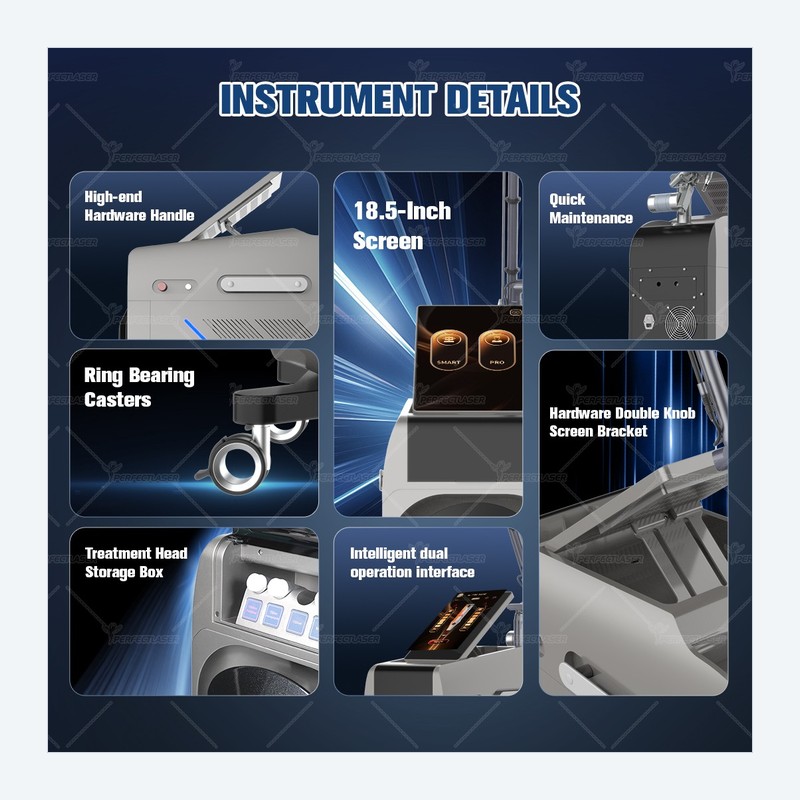
If a documented process is part of your purchase criteria, ask the الليزر المثالي team for the configuration record, test documentation and service terms for the unit you are considering — a Pico Laser Tattoo Removal Machine bought with its build record is one you can maintain on evidence rather than on assumption.
 English
 Arabic
 Chinese
 Dutch
 French
 German
 Italian
 Portuguese
 Russian
 Spanish