
Short answer: the journey from factory to treatment room is a sequence of handovers, and each one needs a document. Freight terms decide who carries the risk in transit, customs documentation decides whether the crate moves at all, and commissioning decides whether the machine starts earning that week or waits for a second visit. Buyers who plan the sequence get a machine that works on arrival.
Importing a laser is not like receiving a piece of office equipment. The crate crosses jurisdictions, changes hands between carriers, and arrives with a documentation file that an inspector, an insurer and a service engineer will all want to see. Owners who understand the sequence spend their effort on the handovers; owners who do not spend it on the phone, tracing a delivery or explaining to a training team why the machine cannot be switched on. The full story of a Pico Laser Tattoo Removal Machine import runs from the quotation’s freight terms to the commissioning sign-off, and this guide walks that path stage by stage with the documents each stage requires.

Freight Terms: Who Carries the Risk, and When
The incoterm on the quotation is the single most consequential line in the shipping plan, because it decides where the supplier’s responsibility ends and yours begins. A price quoted to the factory door leaves you arranging collection, export paperwork and transit insurance; a delivered price carries the crate further but still splits the cost of duties, unloading and site delivery according to the term named. The practical questions are the same whichever term you agree: who insures the machine in transit and for what value, and who is responsible if the crate arrives damaged. Ask for the term to be written on the quotation alongside the freight cost, and confirm in writing what the price excludes — because the excluded lines are where surprise costs live. If a quotation does not name an incoterm, treat the freight figure as incomplete until it does.
Customs, Duties and the Documentation File
Customs clearance is a documentation exercise, and the file should be assembled before the machine ships rather than after it lands. The standard items are the commercial invoice, the packing list, the bill of lading or airway bill, the certificate of origin where applicable, and the equipment’s regulatory documentation — for this picosecond configuration the FDA/RoHS/CE file, which also serves as the evidence an insurer or inspector will ask to see later. Duties and taxes are set by your own jurisdiction and by the classification of the goods, and they should be estimated by your customs broker in writing before you commit to the order, since they belong in the delivered cost rather than in the month the crate arrives. Two details are worth confirming early for a laser specifically: whether any local pre-shipment or radio-frequency requirements apply, and whether the destination address can accommodate a crate of the size shipped. The broker’s written estimate is also what makes a delivered-price comparison between suppliers honest.

On Arrival: Inspection and Unpacking Discipline
Inspection begins before the crate is moved, and it exists to protect a claim. Photograph the crate on arrival — all faces, the seals, and any visible damage — before signing the carrier’s delivery note, and record the note’s conditions rather than signing a clean receipt for a dented package. Then unpack methodically with the packing list in hand, checking each item off and setting aside the accessories, handpieces and documentation as you go. Test that nothing has been crushed or damp, and store the packing materials until commissioning is complete, because they are what you need if a return becomes necessary. A room that follows that discipline has a documented condition on arrival, which is the only basis on which a transit claim or a warranty question can be answered fairly later.
Installation and Commissioning Day
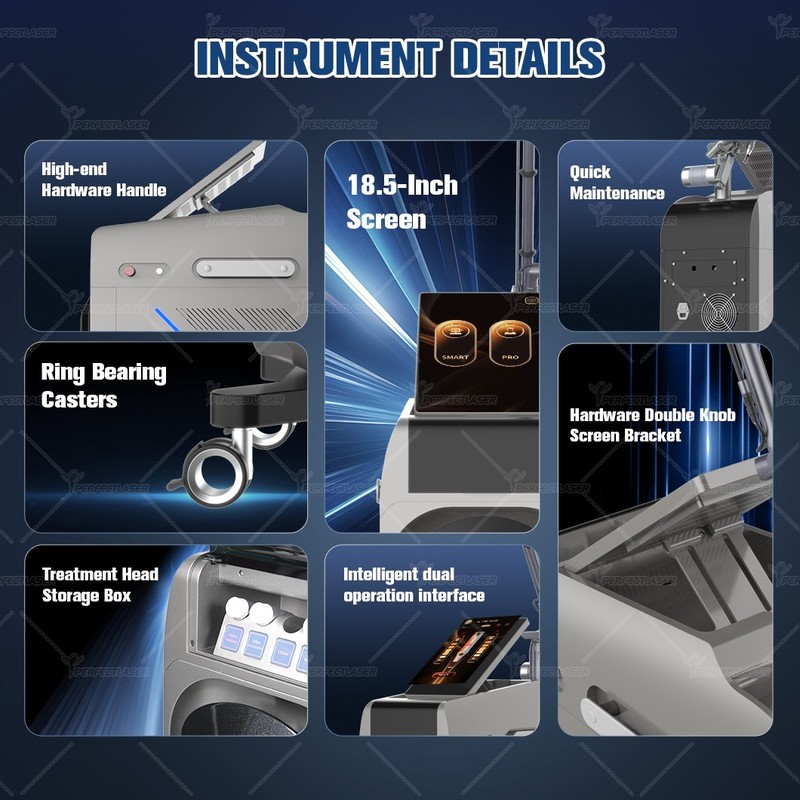
Commissioning should be booked before the delivery date, not after, because it brings together the people whose schedules otherwise drift: the commissioning engineer, your electrician, the operator who will run the machine, and whoever signs for the business. Before that day, the site work should be complete — the dedicated circuit specified against the picosecond console’s 110V/220V requirement, ventilation and climate control within the range the manufacturer documents, and the room cleared so the console goes straight to its position. On the day, walk the installation with the engineer rather than leaving them to it, and ask a question at every stage, because this is the only visit where someone explains the machine while standing beside it. Confirm the handpiece connections, the settings profiles the operator will use most often on the 18.5-inch color screen, and the correct startup and shutdown sequence.
Acceptance Testing and the Sign-Off Record
Acceptance testing turns delivery into a verifiable event. Run the machine through the checks the manufacturer’s documentation specifies, record what was measured against what was commanded, and include a supervised trial at representative settings — the configuration supports an energy range of 100–500mJ at 1–10Hz, so the test should cover more than one point inside that envelope rather than a single demonstration. Record the unit’s serial number and its exact configuration, including the wavelength set, so that the delivered machine can be matched against the quotation without argument. Then capture the written sign-off: what was tested, what was found, what was adjusted, and what remains outstanding. A commissioning record that lists the serial number, the configuration and the test results is the document that supports a warranty claim and answers an insurer’s question about how the equipment was verified.
Handover: Training, Warranty and Service Contacts
The handover is the part of the process most often treated as an afterthought, and it is where the machine becomes usable. Before the engineer leaves, obtain four things in writing: the training outline and who delivers it, the warranty terms and the route for raising a claim, the spare-parts list with lead times and replacement costs for the wear items, and the named service contact for your region. Then book the follow-up — a training session, a review call or a configuration question you want answered — on a date in the calendar rather than in a promise. Keep the whole package together in one file: the quotation, the freight and customs documents, the packing list, the commissioning record, the certificates and the service contacts. Two years later, when a part needs replacing or a question needs answering, that file is the difference between a two-day resolution and a two-week investigation.
| Stage | What to complete | Document to keep |
|---|---|---|
| Order | Freight term named, duties estimated | Quotation with incoterm and exclusions |
| Pre-shipment | Import requirements confirmed | Broker’s written estimate and classification |
| Arrival | Inspection before signing | Photographs and annotated delivery note |
| Unpacking | Items checked against the list | Signed packing list with notes |
| Installation | Site work ready, engineer booked | Electrical confirmation and installation notes |
| Commissioning | Tests run and recorded | Acceptance record with serial and configuration |
| Handover | Training, warranty, spares, contacts | Training plan, warranty terms, service contacts |
Coordinating a Remote Purchase
Buying from another country adds one variable to every stage: you cannot walk into the factory when something needs clarifying. The workarounds are procedural rather than technical. Agree milestone payments tied to shipping events — deposit on order, balance against the bill of lading or a pre-shipment inspection — so the money moves with the goods rather than ahead of them. Ask for photographs and a short video of the machine running the tests before the crate is sealed, and, if the order value justifies it, commission a third-party inspection with a written report. Set a working rhythm for questions: one named contact on each side, a defined response expectation, and a rule that anything affecting the schedule is confirmed by email rather than in a call. Then keep the whole correspondence in the same file as the documents, because a written trail is the only asset that behaves the same way in every time zone.
FAQ (questions fréquentes)
1. Which incoterm should I choose when importing a laser?
It depends on how much of the logistics you want to control. Terms that place more responsibility with the supplier cost more but simplify the process; terms that stop earlier cost less but leave you arranging carriage, insurance and clearance. Whichever you agree, have the term named on the quotation with its exclusions listed.
2. How long does shipping and commissioning take?
Transit time, clearance and site scheduling all vary by destination, route and season, and no supplier can commit to a date that depends on customs. Ask for a lead time to shipment in writing, then add your own clearance and site-readiness estimates before you publish an opening date.
3. What should I check before signing for the delivery?
Inspect the crate and photograph it before signing, and note any visible damage on the carrier’s document rather than signing a clean receipt. Unpack against the packing list afterwards and keep the materials until commissioning is complete.
4. Who installs and commissions the machine?
It should be an engineer working to the manufacturer’s documentation, alongside your electrician and the operator who will run the machine. Book that visit before the delivery date, because the people involved rarely share an empty calendar at short notice.
5. What if the machine arrives damaged or incomplete?
Your protection comes from the documents you created at arrival: the photographs, the annotated delivery note and the signed unpacking record. Raise the issue through the route named in the purchase agreement and reference the transit insurance terms rather than dealing with the carrier informally.
If the logistics path is still unclear, ask the laser parfait team to put the shipping terms, the export documentation and the commissioning plan on the same written quotation — the Pico Laser Tattoo Removal Machine that arrives on schedule is usually the one whose paperwork was finished before it shipped.
 English
 Arabic
 Chinese
 Dutch
 French
 German
 Italian
 Portuguese
 Russian
 Spanish