
Short answer: When it comes to CO2 laser vs erbium laser resurfacing, the winner depends entirely on what you’re treating. CO2 laser resurfacing at 10600nm goes deeper, drives stronger collagen remodeling, and delivers more visible skin tightening — but comes with a longer recovery. Erbium (2940nm) heals faster and works well for surface-level texture, fine lines, and clients who can’t afford a week off. For serious wrinkles, significant acne scars, or meaningful skin tightening, CO2 laser is the harder-working technology. This guide walks through the clinical differences so you can match the right tool to the right client.
This is one of those debates that clinic owners and practitioners argue about at every aesthetics conference. CO2 laser resurfacing and erbium both have solid clinical data behind them, and both have genuine strengths. But the honest answer is that CO2 laser and erbium aren’t competing for the same clients — they’re solving different problems at different depths. Here’s how to think through the choice.
How CO2 Laser Resurfacing Actually Works
At 10600nm, the CO2 laser beam is strongly absorbed by water in skin cells. Hit the tissue and those cells vaporize fast — almost no transition period. In fractional mode, the machine fires in a grid pattern: thousands of microscopic columns punching down into the dermis while the surrounding tissue stays completely untouched. Those intact zones are your healing engine. The ablated columns kick off a wound response — new collagen starts building, elastin follows, and fresh epidermal cells resurface from the edges inward.
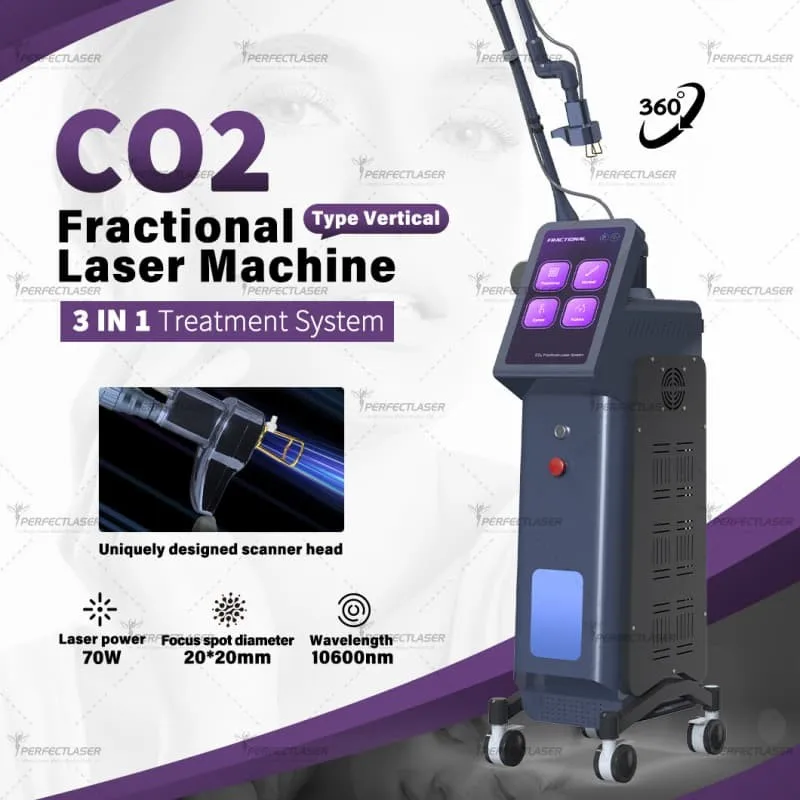
The depth of ablation is controllable through power settings, pulse width, and scan density. A 70W RF tube CO2 system — like the Perfectlaser fractional CO2 machine — can be dialed anywhere from a light surface pass to a deep dermal treatment, which is what gives it such a wide range of clinical applications. The 10600nm wavelength also offers a meaningful coagulation effect as it works, which reduces intraoperative bleeding compared to erbium.
How Erbium Laser Resurfacing Works
Erbium runs at 2940nm — right at the water absorption peak for tissue. That means it removes cells very efficiently per joule of energy, but without leaving much residual heat behind in the surrounding area. The result: clean ablation, less collateral thermal damage, and a healing window that’s noticeably shorter than CO2. Clients are typically back to normal in two to five days rather than a week or more.
The downside is that “less heat” also means less deep collagen stimulation. Erbium doesn’t reach the reticular dermis the way CO2 does. For surface texture — mild lines, early sun damage, light pigmentation — that’s fine. For anything needing structural remodeling deeper in the skin, it runs out of range.
CO2 Laser vs Erbium: Side-by-Side
| Factor | CO2 Laser (10600nm) | Erbium Laser (2940nm) |
|---|---|---|
| Treatment depth | Deep dermis | Superficial to mid-dermis |
| Collagen stimulation | Strong | Moderato |
| Ablation efficiency | Moderato | High (less thermal spread) |
| Coagulation effect | Yes (less bleeding) | minimo |
| Tempo di fermo | 5–14 days | 2–5 days |
| Best for wrinkles | Moderate to deep | Fine to mild |
| Best for scars | Atrophic, rolling, boxcar | Superficial texture |
| Skin tightening | Significant | Mild to moderate |
| Dark skin safety | Requires care, lower settings | Somewhat safer |
| Sessions needed | 1–3 | 2–5 |
Which One Wins for Wrinkles?
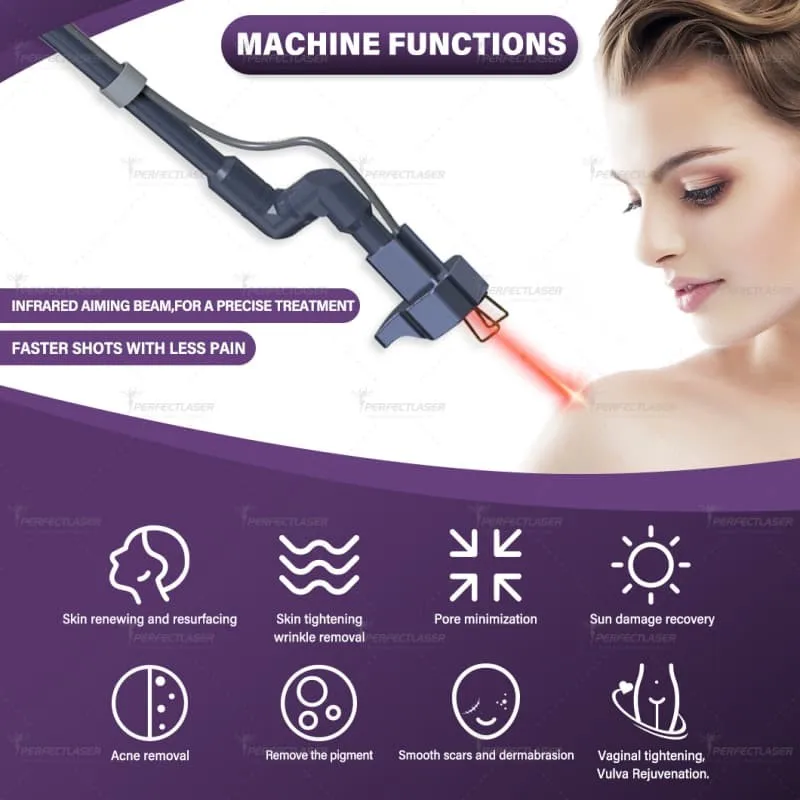
For moderate-to-deep wrinkles — the perioral lines, forehead creases, and neck laxity that clients really want addressed — CO2 is the stronger performer. The deeper collagen remodeling effect at 10600nm reaches the reticular dermis where structural support actually lives. Most published clinical data puts CO2 ahead for wrinkle reduction in the 60–80% improvement range after a single session at appropriate settings.
Erbium makes sense for early intervention: clients in their late 30s to mid-40s with fine surface lines who want something with a fast recovery. It’s also useful for maintenance between CO2 treatments. But if a client is asking “what will actually get rid of these wrinkles,” CO2 laser resurfacing is usually the honest answer.
Which One Wins for Acne Scars?
Scar type matters here more than anything else. Rolling scars and boxcar scars — the ones that sit below the surrounding skin level — tend to respond well to CO2 because the deep ablation physically works through the fibrous scar tissue underneath and gets collagen rebuilding where it’s needed. That’s why fractional CO2 is the go-to choice for moderate-to-severe acne scarring in most dermatology practices.
Erbium has its place for shallow, textural scarring and post-inflammatory pigmentation cases where you’d be overdoing it with aggressive ablation. For a busy clinic handling a range of scar types, a CO2 system with multiple adjustable modes gives you more clinical range than erbium alone — run a light pass on mild texture cases, push deeper on significant scarring, all within one machine and one treatment visit.
Skin Tightening: CO2 Has a Clear Edge
Skin laxity is where CO2’s thermal mechanism becomes an outright advantage. The heat deposited in the dermis causes immediate collagen contraction — clients often see visible tightening the same day — followed by progressive neocollagenesis over three to six months. That combination of immediate and delayed response is what produces the skin-tightening results that erbium simply cannot match at equivalent settings.
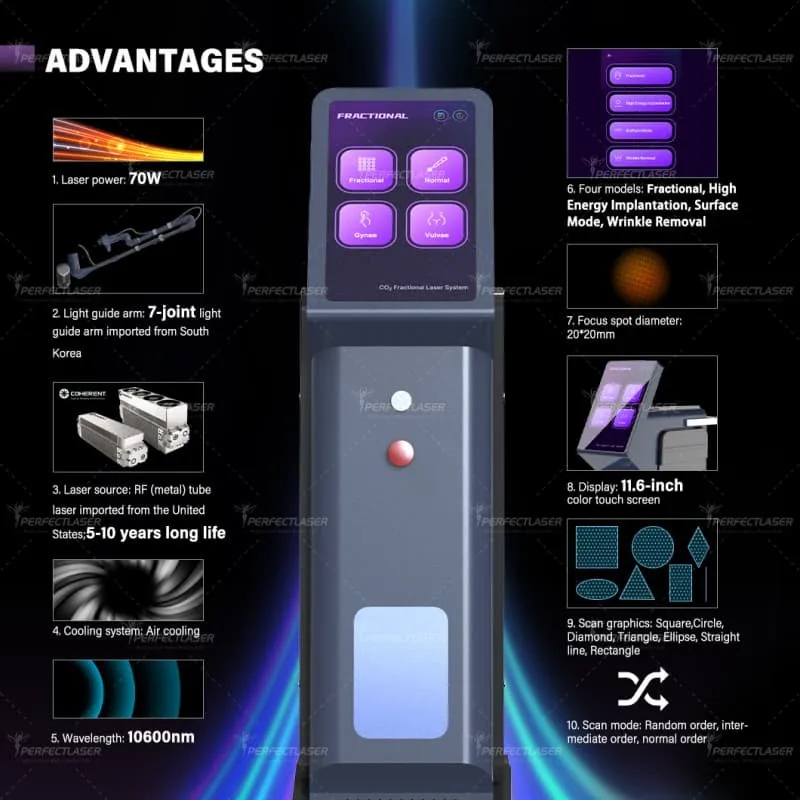
Modern fractional CO2 machines have expanded this further. The Perfectlaser CO2 fractional system, for instance, runs four distinct treatment modes — Fractional, High Energy Implantation, Surface Mode, and Wrinkle Removal — each targeting a different depth and tissue response. The High Energy Implantation mode drives energy deeper into the dermis for maximum collagen stimulation, while Surface Mode handles lighter resurfacing passes. That kind of adjustability means one machine can cover the full spectrum from light skin maintenance to serious rejuvenation without switching platforms.
Downtime: The Honest Tradeoff
This is where erbium wins, and there’s no point pretending otherwise. A fractional CO2 treatment at moderate settings means 5 to 10 days of peeling, redness, and avoiding sun exposure. A deep full-ablation CO2 session can mean two weeks of significant downtime. Clients need to plan around it.
Erbium at comparable scan density typically resolves in two to five days. For clients with demanding jobs, social events, or low pain tolerance, that difference is real and it affects their willingness to commit to treatment. A good consultation conversation acknowledges this directly: “CO2 gets better results, but you’ll need a week off. Erbium is easier on the schedule, but you may need an extra session or two.”
One practical note: fractional delivery has significantly reduced CO2 downtime compared to full-ablation treatments. A conservative fractional CO2 protocol on a 70W machine with appropriate scan density can recover in five to seven days for most clients — still longer than erbium, but not the two-week recovery that older ablative CO2 had a reputation for.
What to Look for in a CO2 macchina laser frazionata
If CO2 is the right call for your clinic, the machine quality determines a lot of the outcome. Key specs worth scrutinizing: laser source (RF metal tube lasts 5–10 years; glass tube systems degrade faster), light delivery system (a 7-joint articulated arm reduces energy loss and fatigue vs. fiber delivery), pulse width range (0.1ms to 100ms gives you the flexibility to go aggressive or conservative), and treatment modes (the more modes, the wider the clinical range you can cover without additional equipment).
Screen interface matters more than it sounds — a 11.6-inch color touch screen with clearly labeled mode selection, live parameter preview, and Manual/Smart mode switching reduces training time and operator error. Scan pattern variety (square, circle, diamond, triangle, ellipse, rectangle) lets you adapt to facial contours rather than forcing the same pattern on every treatment area.
CO2 laser resurfacing sits at the top of the resurfacing hierarchy for a reason. The Perfectlaser fractional CO2 machine — running a 70W RF metal tube at 10600nm — is a good reference point for what a well-specified CO2 system can do across the treatment modes above.
The Bottom Line
For a clinic targeting serious rejuvenation results — wrinkle reduction, CO2 laser scar remodeling, tissue tightening — CO2 laser resurfacing is the more capable platform. A well-specified fractional CO2 laser system with adjustable modes, a quality laser source, and proper delivery optics can handle everything from light maintenance passes to deep dermal remodeling, making it the more versatile long-term investment for most clinical settings.
Domande frequenti
1. Is CO2 laser resurfacing more painful than erbium?
Generally yes, though both are performed with topical anesthetic and the difference is manageable. CO2 at deeper settings produces more heat sensation during treatment and more post-treatment discomfort in the first 24–48 hours. Modern fractional delivery and good cooling protocols reduce this considerably. Most clients rate fractional CO2 treatments as a 3–5 out of 10 on discomfort with proper numbing cream applied 30–45 minutes before.
2. How many sessions of CO2 laser does it take to see results?
Many clients see significant improvement after a single fractional CO2 session. For moderate-to-severe acne scarring or deep wrinkles, two to three sessions spaced six to eight weeks apart delivers the best cumulative outcome. Erbium typically requires more sessions — three to five — to reach comparable results for the same indication.
3. Can CO2 laser be used on dark skin?
Yes, with appropriate settings. Fitzpatrick IV–VI clients need lower fluence, longer pulse widths, and more conservative scan density to minimize post-inflammatory hyperpigmentation risk. Fractional delivery is preferable to full ablation for darker skin tones. Some practitioners prefer erbium for very dark skin due to its lower thermal spread, but experienced operators achieve good CO2 results across all skin types with proper protocols.
4. What is the difference between fractional and full ablative CO2 laser?
Full ablative CO2 removes the entire surface layer across the treated area — maximum results, maximum downtime (up to two weeks). Fractional CO2 fires in a pattern of microscopic columns with untouched skin in between, preserving healing reservoirs. Fractional is now the standard for most clinical applications because it delivers 70–80% of the results with significantly less recovery time and lower risk of complications.
5. How long do CO2 laser resurfacing results last?
Results from a well-executed CO2 fractional treatment typically last three to five years for skin tightening and wrinkle reduction. Collagen continues to remodel for up to six months after treatment, so the final result is often better than what clients see at the one-month mark. Sun protection and a consistent skincare routine significantly extend the longevity. Most clients do a maintenance session every two to three years rather than waiting for full reversal.
 English
  Arabic
  Chinese
  Dutch
Dutch  French
  German
  Italian
  Portuguese
  Russian
  Spanish