
Short answer: Q switch laser and picosecond laser both remove tattoos — but they work differently, cost differently, and perform differently depending on ink color, skin tone, and how many sessions a client can commit to. Q switch laser tattoo removal machines are the proven workhorse of the industry. Picosecond adds speed on certain ink types. Understanding the actual clinical difference helps clinic owners make the right equipment investment and helps clients set realistic expectations before their first session.
The “pico vs. Q switch” question comes up constantly in aesthetic laser consultations, and honestly, it gets muddied by marketing. Brands like Perfectlaser have moved toward hybrid platforms that combine both modes — which actually makes the comparison more relevant, not less. Here’s what the physics and clinical outcomes actually show.
How Q Switch Laser Tattoo Removal Works
A Q switch laser fires pulses in the nanosecond range — typically 5–20 nanoseconds. At that pulse duration, the primary mechanism is photothermal: the laser energy heats ink particles so rapidly that they shatter. The Q-switching mechanism (which gives the technology its name) stores energy in the optical cavity and releases it in a single concentrated burst, achieving peak powers in the megawatt range even at modest average output.
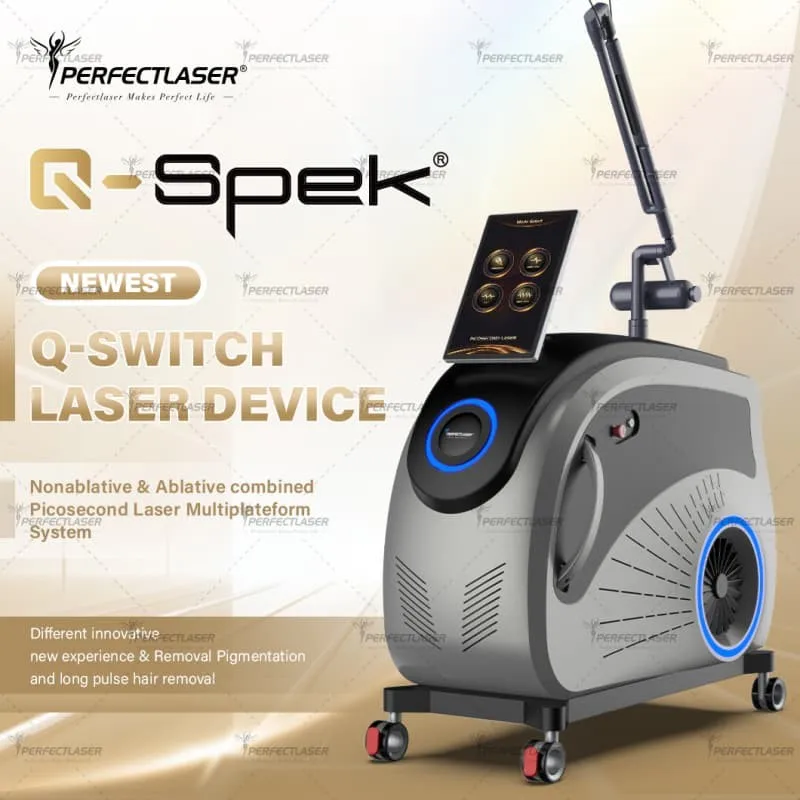
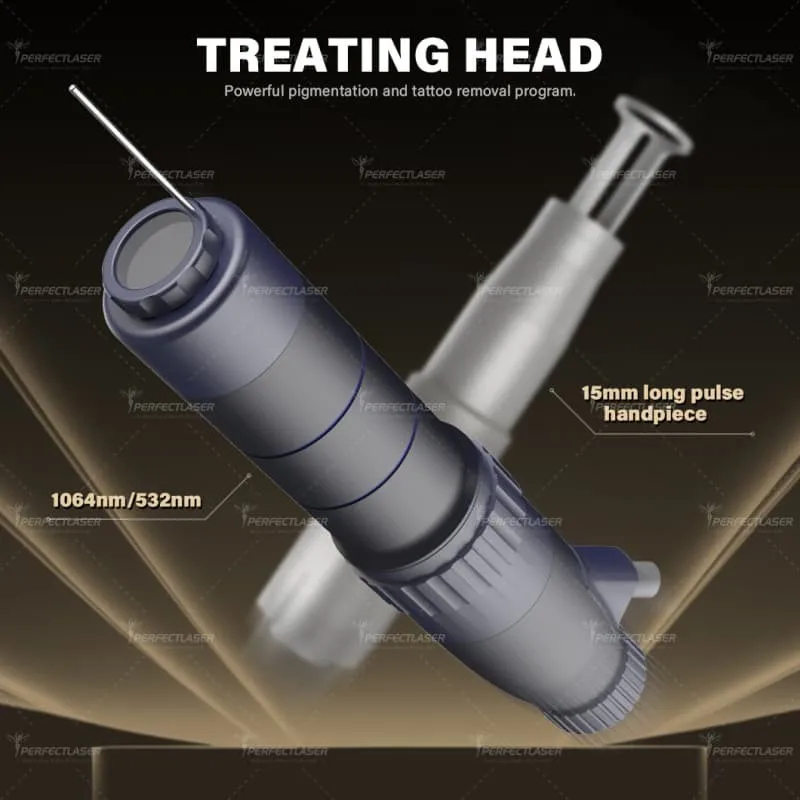
The shattered ink fragments are absorbed by macrophages and gradually eliminated through the lymphatic system. That process takes 6–8 weeks per session, which is why Q switch laser tattoo removal requires multiple visits. The 1064nm wavelength targets black and dark blue ink with high efficiency. The 532nm wavelength (frequency-doubled) handles red, orange, and warm-toned pigments. Optional wavelengths at 585nm and 650nm extend coverage to green and teal inks that standard dual-wavelength systems leave behind.
How Picosecond Laser Works — and What’s Actually Different
Picosecond lasers fire at 100–750 picoseconds — roughly 10 to 100 times shorter than a nanosecond pulse. At this timescale, the interaction shifts from purely photothermal to predominantly photomechanical. Instead of heating and fracturing ink particles, pico pulses create a pressure wave that physically explodes the pigment into smaller fragments. Smaller fragments mean faster immune clearance, which theoretically means fewer sessions.
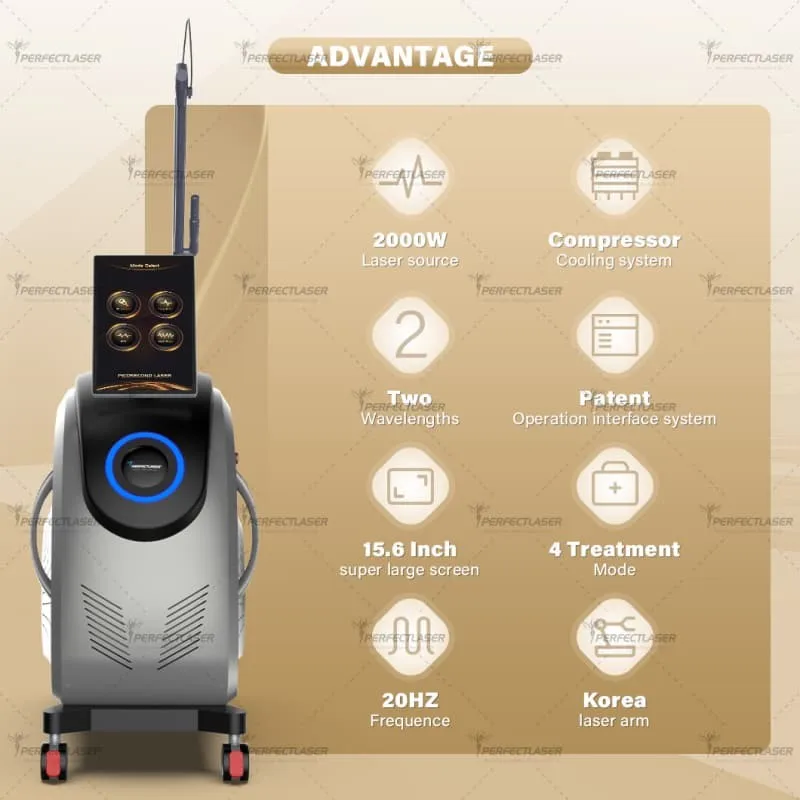
Modern professional Q switch laser tattoo removal machines bridge this gap by incorporating a picosecond mode alongside the traditional nanosecond Q-switch mode. The Perfectlaser Q-Spek system does exactly this — running picosecond treatment for tattoo and pigmentation work, then switching to PTP mode for chloasma, Multi Pulse for carbon peel, or Long Pulse for hair removal in the same clinical session. That kind of platform flexibility changes the ROI calculation significantly compared to buying a standalone pico-only device.
Clinical Performance: Where Each Technology Wins
Black and Dark Ink
Both technologies perform well on black tattoo ink at 1064nm. Q switch laser achieves reliable clearance in most cases, and experienced practitioners often achieve comparable session counts to picosecond on straightforward professional black tattoos. The advantage of pico mode on black ink is most visible on very dense, heavily saturated tattoos where smaller particle shattering makes a measurable difference in per-session clearance.
Colored Ink
This is where wavelength selection matters more than pulse duration. Green and teal inks respond better to 650nm or 694nm (ruby) than to 532nm, regardless of whether you’re running nanosecond or picosecond pulses. A Q switch laser tattoo removal machine with optional 585nm and 650nm handpieces covers the spectrum more completely than a picosecond-only system that only offers 532nm and 1064nm.
Skin Tone and Safety
For darker skin tones (Fitzpatrick IV–VI), pulse duration matters. Shorter pulses mean less thermal diffusion into surrounding tissue, which is a genuine advantage of picosecond mode on clients where post-inflammatory hyperpigmentation is a concern. Running Q switch at 1064nm with appropriate fluence is also well-tolerated on dark skin — but the pico mode gives practitioners an additional margin of safety for the clients who need it most.
Pigmentation and Skin Rejuvenation
For benign epidermal and dermal pigmentation — sunspots, melasma, café-au-lait spots — both Q switch and picosecond modes work, but the approach differs. PTP (Photo Thermal Pulse) mode, available on advanced Q switch systems, delivers a controlled biphasic energy pattern specifically designed for safer melasma treatment, reducing the risk of paradoxical darkening that can occur when standard settings hit chloasma skin. This is a clinical mode that picosecond-only devices often lack entirely.
Session Count: The Honest Comparison
Marketing claims that picosecond laser requires half the sessions of Q switch are rarely supported by independent clinical data. The reality is more nuanced:
- Amateur tattoos (single-layer, lower ink density): 4–6 sessions with either technology
- Professional black tattoos: 6–10 sessions Q switch; 5–8 sessions pico (modest advantage)
- Multi-color professional tattoos: highly variable; wavelength coverage matters more than pulse duration
- Cosmetic tattoos (eyebrow, lip liner): 3–5 sessions; Q switch PTP mode often preferred for facial pigment safety
The session gap narrows considerably when comparing a high-energy Q switch laser tattoo removal machine (1200mJ at 1064nm, 20Hz) against entry-level picosecond units with limited energy output. Raw fluence delivered per session plays a bigger role than pulse duration alone.
Machine Cost vs. Revenue Model
A dedicated picosecond-only device from a reputable manufacturer typically runs \$20,000–\$60,000. A professional multi-mode Q switch laser tattoo removal machine with picosecond capability built in — like the Perfectlaser Q-Spek platform — costs significantly less while adding Long Pulse hair removal, PTP chloasma treatment, and Multi Pulse carbon peel to the treatment menu. For clinics building a multi-treatment revenue model rather than tatoo removal specialty, the economics strongly favor a hybrid platform.
Factor in: each carbon laser facial generates \$80–\$150 per session with 20-minute treatment time and no consumables. Adding 10 of those per week to a clinic’s schedule, supported by the Multi Pulse mode on a Q switch system, pays for a significant portion of the machine cost in the first year.
Which One Should a Clinic Buy?
The right answer depends on your client base and revenue goals:
- Tattoo removal specialty clinic: a high-energy Q switch laser tattoo removal machine with picosecond mode covers the full clinical range; standalone pico is overkill for most practical use cases
- Multi-treatment aesthetic clinic: a four-mode Q switch system (Pico + Long Pulse + PTP + Multi Pulse) maximizes per-machine revenue across skin types and indications
- High-end boutique clinic, premium pricing: a dedicated picosecond device makes sense if the client base expects and will pay a premium specifically for “picosecond” branding
FAQ
1. Does picosecond laser hurt less than Q switch laser tattoo removal?
Most clients report comparable discomfort between the two technologies at equivalent fluence levels. The shorter pulse duration of pico doesn’t significantly change the sensation for most people. Treatment area, ink density, and individual pain threshold matter far more than pulse duration. Both technologies are typically performed with topical numbing cream applied 30–45 minutes before the session.
2. Can a Q switch laser remove permanent makeup?
Yes, and it’s one of the most in-demand applications for Q switch laser tattoo removal machines. Cosmetic tattoos — eyebrows, eyeliner, lip liner — use iron-oxide or titanium-dioxide pigments that can paradoxically darken with standard settings. The PTP (Photo Thermal Pulse) mode on professional Q switch systems is specifically designed for safer cosmetic tattoo removal, delivering controlled energy that reduces this risk. Always patch-test cosmetic tattoo removal on a small section before treating the full area.
3. How long does each Q switch laser tattoo removal session take?
Small tattoos under 4cm² typically take 5–10 minutes per session. A medium palm-sized tattoo runs 15–25 minutes. Large back or sleeve tattoos may require 45–60 minutes. A machine running at 20Hz with a 6mm spot size covers area quickly enough that even large tattoos can be completed in a single visit without energy fatigue affecting later passes — this is where a 2000W laser source and triple-cooling system make a practical difference in session efficiency.
4. What ink colors are hardest to remove with a Q switch laser?
Light greens, teals, light blues, and yellow are the most challenging. These colors absorb poorly at both 1064nm and 532nm. Optional wavelength handpieces at 585nm and 650nm significantly improve clearance on these colors. Yellow is the most resistant across all laser technologies and often requires more sessions regardless of whether you’re using Q switch or picosecond. Flesh-toned and white inks contain titanium dioxide and can paradoxically darken — always patch-test these first.
5. What’s the difference between PTP mode and standard Q switch mode?
PTP (Photo Thermal Pulse) delivers energy in a split-pulse format — the laser fires twice in rapid succession at reduced individual fluence, rather than once at full fluence. This biphasic delivery reduces peak thermal stress on melanocytes, making it safer for treating chloasma (melasma) where standard Q switch settings can trigger paradoxical darkening. PTP mode is also used for gentle toning treatments and post-inflammatory hyperpigmentation, making it one of the most clinically useful modes on a multi-mode Q switch laser tattoo removal machine.
 English
  Arabic
  Chinese
  Dutch
Dutch  French
  German
  Italian
  Portuguese
  Russian
  Spanish