
At a glance: CO2 fractional laser machines work by sending narrow columns of laser energy into skin tissue — creating controlled micro-injuries that kick off collagen regeneration, all while keeping the surrounding surface intact. If you’re in the market for one, what actually separates a reliable clinical workhorse from a three-year headache is the quality of the laser source, how fast the scanning system fires, and whether the manufacturer stands behind it after the sale.
Ask anyone who’s been running a medspa for more than five years and they’ll tell you the same thing: a bad equipment purchase doesn’t announce itself upfront. The machine works fine in the first six months. Then the tube starts losing output. Then the galvanometer drifts. By the time the problem is obvious, the warranty window has closed and the supplier has stopped returning emails. This guide is the list of questions we wish more buyers had asked before signing.
How CO2 Fractional Lasers Actually Work
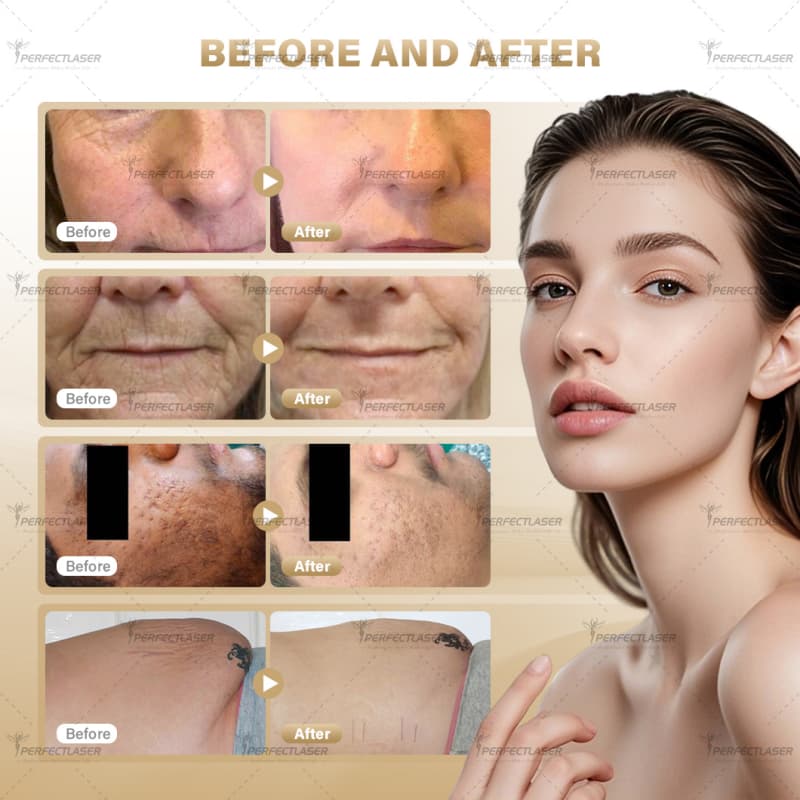
The CO2 laser operates at 10,600nm — a wavelength that tissue water absorbs very readily. That absorption is what makes it such a precise skin tool. In fractional mode, the beam gets broken up into a grid of tiny energy columns, each one creating a narrow wound track in the dermis while the skin between those tracks stays untouched. Your body reads each track as damage that needs fixing, triggers a repair cascade, and lays down fresh collagen in the process. Over several weeks, you end up with skin that’s structurally denser than before.
The older version of this technology — full ablative CO2 — vaporized the entire surface within the treatment zone. Results were dramatic but so was recovery: two weeks of raw, weeping skin and a real infection risk. Fractional delivery gets you most of the same collagen response with five to seven days of downtime instead. That tradeoff is why fractional CO2 became the clinical standard, and why it’s still the tool most practitioners reach for on moderate-to-severe skin aging and scarring.
What to Check Before You Buy
1. Laser Power: 80W Is the Professional Benchmark
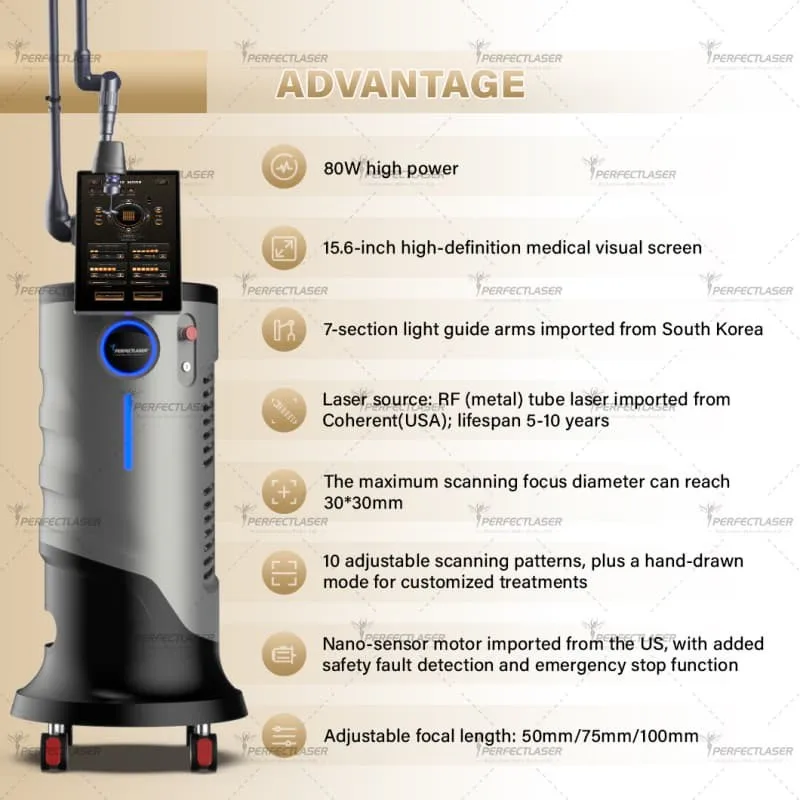
Consumer-grade CO2 units often run at 30-40W. Professional clinic machines need enough power to reach therapeutic energy levels quickly, treat large areas efficiently, and maintain consistent output session after session. 80W is the current standard for a serious clinic machine, and anything below 60W should prompt you to ask why. Power isn’t everything — delivery efficiency matters too — but it sets the ceiling for what the machine can do.
2. Scanning Speed and the Pain Equation
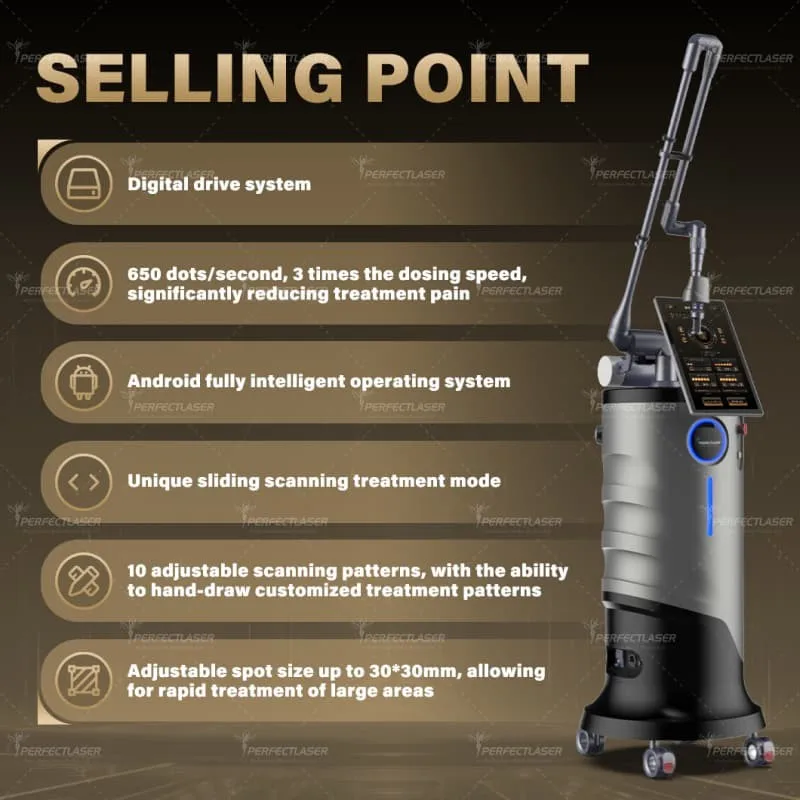
Here’s something most spec sheets don’t explain clearly: the faster a CO2 laser deposits each microbeam, the less heat accumulates in surrounding tissue, and the less pain the client feels during treatment. A slow machine has to use lower energy settings to stay safe, which limits results. A fast digital-drive system can fire at 650 dots per second or more — that’s three times the speed of older analog systems — which means you can push effective energy levels while keeping the treatment tolerable.
This is why the drive system matters as much as the wattage. Digital galvanometer control is now the benchmark; analog steppers are slower, less precise, and harder to maintain. When you’re comparing machines, ask specifically whether the galvanometer is digital or analog. The answer tells you more than the power rating.
3. Spot Size Range: Bigger Isn’t Always Better, But Bigger Helps
The scanning head size determines how quickly you can cover a treatment area. A 10×10mm head is precise but slow on large areas. A 30×30mm head — the largest currently available in clinical machines — can sweep a full face in a fraction of the time. The practical implication for your clinic: shorter treatment times mean more clients per day, lower per-session overhead, and better client experience.
Look for a machine with interchangeable heads — at minimum 10×10, 20×20, and 30×30mm — plus a sliding mode for continuous coverage of larger body areas like backs or thighs. Adjustable focal length (50mm, 75mm, 100mm) is another often-overlooked spec that affects how precisely energy is delivered at different treatment depths.
4. Treatment Modes: One Machine, Many Protocols
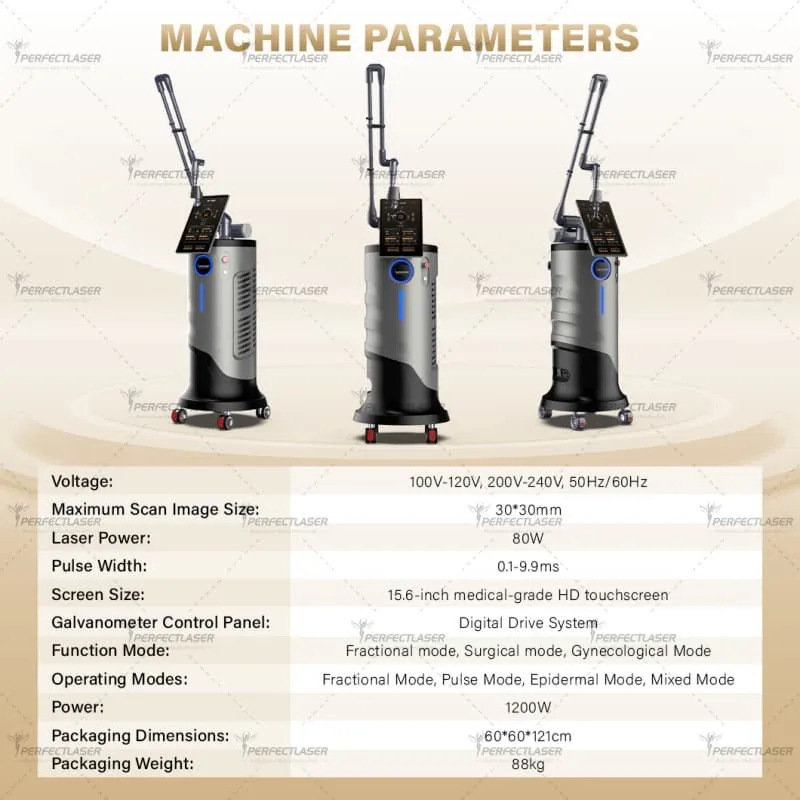
A clinic-grade CO2 fractionele lasermachine should support multiple operating modes, not just fractional. Here’s what to look for:
- Fractional Mode — standard for skin resurfacing, scar remodeling, anti-aging
- Surgical Mode — precise cutting for lesion removal and minor procedures
- Epidermal/Surface Mode — shallow 20-40 micron treatment targeting the stratum corneum, ideal for improving skin tone with minimal downtime
- Mixed/Pulse Mode — combinations that address both epidermal and dermal layers simultaneously
- Gynecological Mode — increasingly requested by medspas adding vaginal rejuvenation services
The breadth of modes determines how many revenue streams the machine can support. A machine with only one or two modes limits your service menu immediately.
5. The Laser Source: Where the Quality Lives
Inside the machine, the laser tube is what actually produces the beam. RF-excited metal tube lasers — particularly those sourced from manufacturers like Coherent in the US — are the current standard for longevity and output stability. A good RF metal tube should last five to ten years under clinical use. Cheaper glass tube CO2 lasers degrade faster, produce less stable output, and often need replacement within two to three years.
Ask the manufacturer what brand of laser tube they use and where it’s sourced. If they can’t or won’t tell you, that’s your answer. Reputable manufacturers source components from established suppliers and document it — that documentation should be available on request.
6. Safety Systems and Fault Detection
CO2 lasers carry real clinical risks — they operate at wavelengths that can damage skin if parameters drift or components fail mid-treatment. A professional machine should have real-time fault monitoring, automatic shutdown on anomaly detection, and protection against multiple failure modes. Look for machines that specify the number of fault types monitored (37 is a concrete figure you’ll see from serious manufacturers) and that include both automatic emergency stop and manual override.
7. Screen and Software: The Operator’s Interface
A 15.6-inch medical-grade HD touchscreen with an Android-based operating system is now the practical standard for a professional CO2 machine. What matters operationally is how presets work, whether the system supports custom treatment patterns (hand-drawn protocols for unusual treatment areas are a genuine clinical advantage), and how easy it is for technicians to navigate under pressure. Slow or clunky software adds minutes to every session and frustrates staff.
What Conditions Does It Treat? And What It Doesn’t Fix
CO2 fractional laser is one of the most versatile skin tools in a clinic’s arsenal. Conditions with strong published evidence include:
- Fine lines and deep wrinkles, especially around the eyes and mouth
- Atrophic acne scars — fractional CO2 is consistently ranked among the most effective options
- Sun damage, pigmentation, and uneven skin tone
- Enlarged pores and skin texture irregularities
- Surgical and traumatic scars, including hypertrophic scars
- Loose skin on the face, neck, and body areas
- Vaginal laxity and mucosal rejuvenation (with appropriate probes)
What CO2 doesn’t do well: it’s not a first choice for active inflammatory acne, deep vascular lesions, or very dark skin tones at high settings (Fitzpatrick V-VI requires conservative parameters and an experienced operator). It also doesn’t replace injectables for volume loss.
Downtime and Sessions: What to Tell Clients Honestly
Fractional CO2 downtime ranges from three to seven days depending on treatment intensity. Clients should expect redness, swelling, and peeling. Most clients see meaningful improvement after a single aggressive session, though a course of two to three sessions at moderate settings often produces comparable results with less single-event downtime. Annual maintenance sessions are common for anti-aging indications.
Per-session clinic pricing in the US runs from $500 to $3,000 depending on area size and treatment depth. This makes it one of the highest-revenue-per-hour services a clinic can offer.
What the Machine We Build Looks Like Inside
Bij Perfectlaser, our CO2 fractional laser — the iSpeed CO₂ — is built around the specifications above, not around what looks good on a brochure. The laser source is a Coherent RF metal tube rated for five to ten years of clinical use. The galvanometer is a digital-drive system capable of 650 dots per second, three times the speed of analog alternatives. The scanning head reaches 30×30mm maximum, with three interchangeable sizes and a sliding mode for large-area work. The operating system runs on Android with a 15.6-inch medical-grade screen, adjustable focal length across 50mm, 75mm, and 100mm, ten scanning patterns plus hand-draw mode, and real-time fault monitoring across 37 failure types.
The machine supports fractional, surgical, gynecological, surface, mixed, pulse, and sliding modes — a service menu broad enough to justify the purchase price from multiple revenue streams simultaneously.
We’re manufacturers, so we’re obviously not a neutral source. But the questions in this guide are the same ones we’d want any buyer to bring to any vendor — including us.
ROI: What the Numbers Look Like for a Busy Clinic
A professional CO2 fractional laser machine sits in the $12,000 to $30,000 range for mid-tier clinical units, with premium-branded options going considerably higher. That number looks large until you run the session math. A single full-face fractional treatment in the US is priced between $1,500 and $3,000. At five clients per week — a conservative figure for a machine positioned as a premium offering — that’s $7,500 to $15,000 in weekly revenue from one device. Most clinics recover the machine cost within two to four months of consistent use.
The margin structure is also favorable: CO2 fractional treatments have essentially zero consumable cost. Unlike injectables, there’s no product to buy per session. The ongoing expenses are maintenance, electricity, and operator time. That makes it one of the cleanest revenue streams in the aesthetic medicine space. Add vaginal rejuvenation and surgical mode services and you’re looking at revenue from three distinct service categories from a single machine investment.
Where clinics underperform on ROI is by not training staff thoroughly on the full capability of the machine, or by restricting it to one or two treatment types out of uncertainty about other modes. A machine that supports fractional, surgical, surface, mixed, and gynecological modes — and whose staff knows how to use all of them — will outperform a comparable machine at a clinic that uses only the basic fractional mode.
After-Sales Support: The Factor Nobody Talks About
A CO2 fractional laser running at 80W puts serious demands on its components — the laser tube, the galvanometer, the cooling system, the power supply. Things will occasionally need attention. The question is whether your supplier answers when you call. Ask about: warranty terms (specifically whether the laser tube is covered), the average response time for technical support requests, whether spare parts are stocked and how long shipping takes, and whether software updates are included. A supplier who can give confident, specific answers to all four is worth paying more for. One who hedges on warranty terms or support timelines is telling you something important about what happens after the sale.
The Bottom Line
A CO2 fractional laser machine is a long-term clinical asset, not a commodity purchase. Evaluate laser source quality, scanning system type, power output, mode breadth, safety monitoring, and post-sale support — in that order. Price is a factor, but a machine that underperforms or fails after eighteen months costs more than a well-specified unit at a higher initial price. Get the hardware right, and the revenue follows.
Veelgestelde vragen
1. How long does a CO2 fractional laser treatment take?
A full-face fractional CO2 session typically runs 20 to 45 minutes, depending on the scanning head size, energy settings, and number of passes. Machines with larger spot sizes (30×30mm) and faster scanning speeds can complete the same coverage area significantly faster than older or smaller-head units, which translates directly to clinic throughput.
2. How many sessions does a client need?
For moderate skin aging and mild scarring, one to two sessions at moderate settings often deliver visible improvement. More significant concerns — deep wrinkles, dense acne scarring, loose skin — typically require two to four sessions spaced six to eight weeks apart, followed by annual maintenance. Results continue improving for three to six months after treatment as new collagen matures.
3. Is CO2 fractional laser safe for darker skin tones?
It can be, with appropriate parameter adjustments. Darker skin (Fitzpatrick IV-VI) requires lower fluence, longer pulse widths, and extended intervals between sessions to reduce the risk of post-inflammatory hyperpigmentation. An experienced operator with adjustable pulse width control and conservative settings can treat darker tones safely. Patch testing is always recommended before a full treatment.
4. What is the lifespan of a professional CO2 laser machine?
A machine built around a quality RF metal tube laser — such as those sourced from Coherent — is rated for five to ten years of clinical use under normal operating conditions. The actual lifespan depends on usage volume, maintenance practices, and cooling system condition. Digital-drive galvanometers also outlast analog steppers significantly.
5. What should I ask a CO2 laser machine supplier before buying?
Ask: What brand and type is the laser tube? Is the galvanometer digital or analog? What is the maximum scanning speed in dots per second? How many fault types does the safety system monitor? What is the warranty on the laser tube specifically? Can you provide references from clinics in my country currently using this machine? A supplier who can answer all six confidently is worth talking to further.
 English
  Arabic
  Chinese
  Dutch
Dutch  French
  German
  Italian
  Portuguese
  Russian
  Spanish