
Short answer: buying machines for several locations is a network decision, not a bigger version of a single purchase. Volume earns you real bargaining power, and it also obliges you to standardise the specification, plan logistics into more than one building, and design service cover that works across every site — the parts that decide whether a rollout strengthens the brand or splinters it.
Multi-site operators arrive at this problem from different directions: a clinic opening its second room, a studio group acquiring a competitor, a franchise building a standard kit. What they share is that every decision now repeats, and a mistake in the specification is no longer one machine’s problem. Consistency becomes an asset — a client should meet the same platform, the same protocol and the same standard of documentation whichever location they walk into. It is also the discipline that earns a supplier’s best commercial terms, because a group that knows exactly what it is buying is easy to price. The specification lines for a Pico Laser Tattoo Removal Machine are the same ones a single buyer compares, but the weight they carry changes once several sites depend on them.

Why Multi-Site Sourcing Is a Different Exercise
At a single site, variance is survivable. Two machines from different suppliers, or two configurations of the same platform, cost you some convenience and a little training time. Across five sites the same variance compounds into a real operating problem: parts that do not interchange, protocols that diverge, a technician who must learn two systems, and a client experience that differs by postcode. The economics also change shape. Volume buying shifts the conversation from unit price to total arrangement — price steps, payment stages against deliveries, production slots, spare-parts pools and service response times — and those terms are worth more over a rollout than a headline discount. The strategic question is whether the group wants to be one brand operating a standard platform or a collection of businesses sharing a name, and procurement is where that question gets answered.
Standardising the Specification Across Sites
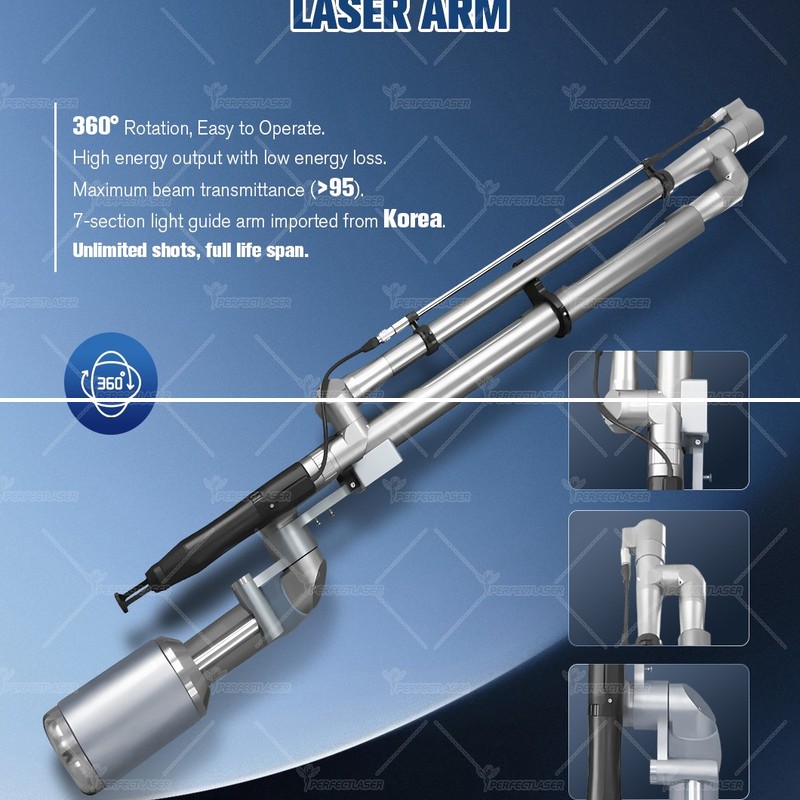
Standardisation starts with a written specification that every site order is measured against. For this picosecond platform the core lines are stable: 1064/532, 755 and 1320 as standard wavelengths with 585nm and 650nm available as options, a 350ps pulse duration and 1.67GW peak power, an energy range of 100–500mJ at 1–10Hz, a 3000W system with an 18.5-inch color screen and 110V/220V compatibility. A group should decide which of those lines are fixed across the network and which may vary by site — for example, whether every location receives the optional wavelengths or only those whose case mix justifies them. Write that decision down as a configuration baseline with an explicit exception rule, so a site manager cannot quietly order a different machine and a supplier cannot quietly substitute one. The baseline is also what makes each site’s quotation comparable during negotiation.
Volume Terms: Price Steps, Payment Stages and Lead Times
Volume negotiation should produce a schedule rather than a discount. Ask for the price steps attached to quantity bands, the payment stages tied to production and delivery milestones, the production slot lead time for each tranche, and the conditions under which a tranche can be rescheduled. Then price the lines that volume does not obviously touch: freight into several destinations rather than one, duties and clearance per jurisdiction if the sites cross borders, commissioning visits that may need to be grouped geographically, and the spare-parts pool the network will hold. Where the group can standardise, it should expect better terms — one configuration, one documentation pack, one training curriculum and one service agreement are cheaper for a supplier to support than a varied fleet, and a well-prepared buyer can convert that saving into the terms that matter, such as response times and parts availability.
Phased Rollout: Which Site Gets What First
A rollout should be phased deliberately rather than spread evenly. The usual logic is to equip the flagship or highest-volume site first, both because it can absorb the learning curve and because it becomes the reference installation for the others: the configuration record, the settings conventions and the protocol that later sites copy. Equip the second tranche once the first site’s commissioning record, service experience and settings data are documented, so that the lessons travel with the order rather than being rediscovered at each location. Sites with unusual case mixes — heavy cosmetic work, particular skin-type distributions, or a single operator — may justify an exception to the baseline, and the exception should be argued in writing against the case mix rather than granted as a preference. Sequencing also spreads capital and training load, which keeps any single month from absorbing the whole rollout.
Service Contracts, Spare Pools and Uptime Across a Chain
Service is where multi-site operations are won or lost, because a breakdown at one location is now a shortfall in a network. Negotiate the service arrangement as a network agreement: response times in working days, whether visits can cover several sites in one trip, the escalation route when a machine is out of service, and the availability of loan or replacement arrangements if a repair takes time. Then design the spare-parts pool. Holding every wear item at every site is wasteful; holding nothing centrally means each site waits. The practical compromise is a network stock of critical items — handpieces and their internals, the parts the service documentation identifies as replaceable — with a documented reorder level, plus a local shelf for the items each site consumes fastest. Record the warranty terms per unit, since the 2-year warranty and the FDA/RoHS/CE documentation file belong in each site’s own file even though the purchase was central.
Training and Consistency Across Locations
Standardisation only reaches the client if the operators are trained to it. A network should train against one protocol and one settings convention, using the same competence assessment at every site, so that a client moving between locations receives a consistent explanation and a consistent plan. Centralise the training records and the assessment criteria, and require a mentor sign-off before any operator works unsupervised — including at new sites, where the temptation to open quickly is strongest. The settings data that accumulates across the network is one of the genuine advantages of scale: a group can see which approaches produce which observations across a wider range of cases than any single room could collect, and use that to refine its written protocol. Confirm any local training or qualification requirements with the relevant authority and professional body in each jurisdiction, because those obligations follow the site, not the group.
Keeping the Rollout Accountable
An accountable rollout is a set of milestones with documents attached. For each site, record the specification ordered against the network baseline, the delivery and commissioning dates, the acceptance results with the unit’s serial number and configuration, the operator’s competence assessment, and the service contacts for that location. Review the network quarterly against those records: which sites are operating inside the baseline, which exceptions were granted and why, how long any machine was out of service, and what the spare-parts pool actually consumed versus the plan. That review is what turns a one-off procurement into a repeatable programme, and it is also the evidence base when a supplier’s performance needs to be discussed — a conversation that goes better with dates and serial numbers than with impressions.
| Workstream | Network decision | Record to keep |
|---|---|---|
| Specificatie | Fixed baseline plus written exception rule | Configuration baseline per site |
| Commercial terms | Price steps, stages, slots, rescheduling | Volume agreement with the schedule |
| Rollout sequence | Reference site first, then tranches | Milestone plan with dates |
| Service | Network response times and escalation | Service agreement per unit |
| Spares | Central critical stock plus local shelf | Reorder levels and consumption log |
| Training | One protocol, one assessment | Central training records |
| Review | Quarterly performance against plan | Network review summary |
Veelgestelde vragen
1. How many machines do we need before volume pricing applies?
Suppliers set their own quantity bands, and the threshold differs between badge-level supply and configured orders. Ask for the price steps explicitly rather than assuming a number, and compare the total arrangement — lead times, spares and service — alongside the unit price.
2. Should every location have an identical configuration?
A single baseline simplifies training, spares and protocol, and most networks benefit from it. Exceptions are reasonable where a site’s case mix genuinely differs, provided they are argued in writing and recorded so the fleet’s composition stays known.
3. How do we handle service across several cities?
Negotiate a network service agreement covering response times, multi-site visits, escalation and out-of-service arrangements, then hold a documented spare-parts pool. Confirm in writing how a repair at a remote site is handled before the rollout rather than during the first breakdown.
4. Where should the spares be kept?
Critical wear items centrally, fast-moving consumables locally, with reorder levels based on each site’s consumption and the supplier’s lead times. Review consumption against the plan quarterly so the pool reflects what the network actually uses.
5. What should we standardise besides the machine?
The protocol, the picosecond settings conventions, the competence assessment and the documentation set. Standardising those is what makes a client’s experience consistent between locations, and it is what allows settings data from across the network to be useful.

If a multi-site rollout is on the table, send the Perfectlaser team your site list and intended case mix and ask for a phased proposal — a Pico Laser Tattoo Removal Machine planned as a network standard, with the same documentation and service terms at every location, is easier to run than a fleet assembled one order at a time.
 English
 Arabic
 Chinese
 Dutch
 French
 German
 Italian
 Portuguese
 Russian
 Spanish