
Short answer: Not every Q switch laser tattoo removal machine is built the same. The price gap between a \$3,000 entry-level unit and a \$15,000 professional system isn’t arbitrary — it comes down to seven specific components that directly determine how well ink breaks up, how safe the treatment is, and how long the machine lasts under daily clinical use. This guide breaks down exactly what to look for, with real specs to benchmark against.
Clinic owners shopping for a Q switch laser tattoo removal machine for the first time often get overwhelmed by spec sheets. Every manufacturer lists wavelengths, energy output, and pulse width — but few explain what those numbers mean for real treatment outcomes. This guide uses the Perfectlaser Q-Spek as a reference platform to benchmark each spec, since it represents a well-documented professional-grade Q switch laser system with published performance data. Here’s the practical framework used by experienced buyers.
1. Laser Source Power: Why 2000W Changes What’s Possible
The laser source is where everything starts. A 2000W ultra-large laser source delivers enough reserve power to maintain consistent energy output at high repetition rates — which matters when you’re treating large tattoos in clinical volume. Underpowered sources drop energy between shots at 15–20Hz, meaning inconsistent ink shattering and uneven clearance across sessions.
Budget machines often list peak energy numbers that only hold at 1–2Hz firing rates. A professional Q switch laser tattoo removal machine should sustain rated energy at 20Hz continuously. If the spec sheet says “max energy 1200mJ” without specifying at what frequency, ask the manufacturer to confirm sustained output at 20Hz — that single question filters out most of the underpowered units on the market. A Q switch laser system that can’t hold energy at clinical repetition rates is doing less work per session than the numbers suggest.
2. Dual Laser Rods: The Component Most Buyers Miss
Inside the laser cavity, the rod diameter determines how much gain medium is available to amplify the pulse. Most entry-level systems run a single φ7mm rod. A dual-rod configuration — φ7mm combined with φ8mm — provides significantly higher pulse energy ceiling and more stable beam quality across a longer service life.
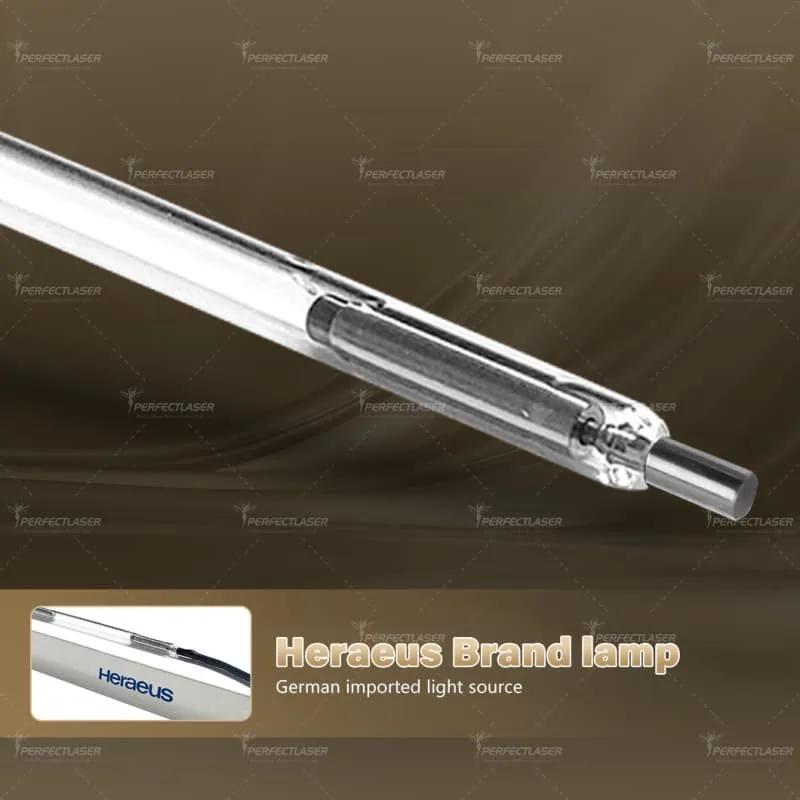
The Nd:YAG rod quality matters just as much as size. Premium rods paired with a Heraeus German-imported lamp (one of the most respected light sources in professional laser systems) produce tighter, more reproducible pulses compared to generic domestic lamp pairings. When the lamp degrades, energy drops and treatment consistency suffers — a German-sourced lamp runs longer and degrades more predictably, giving technicians advance warning before energy falls below clinical threshold.
3. Wavelength Range: Single vs. Multi-Wavelength Systems
A standard Q switch laser runs 1064nm and 532nm. That covers black, dark blue, and red/orange ink reasonably well. The problem is that tattoo ink has expanded dramatically — greens, teals, light blues, and purple tones are notoriously resistant to these two wavelengths.
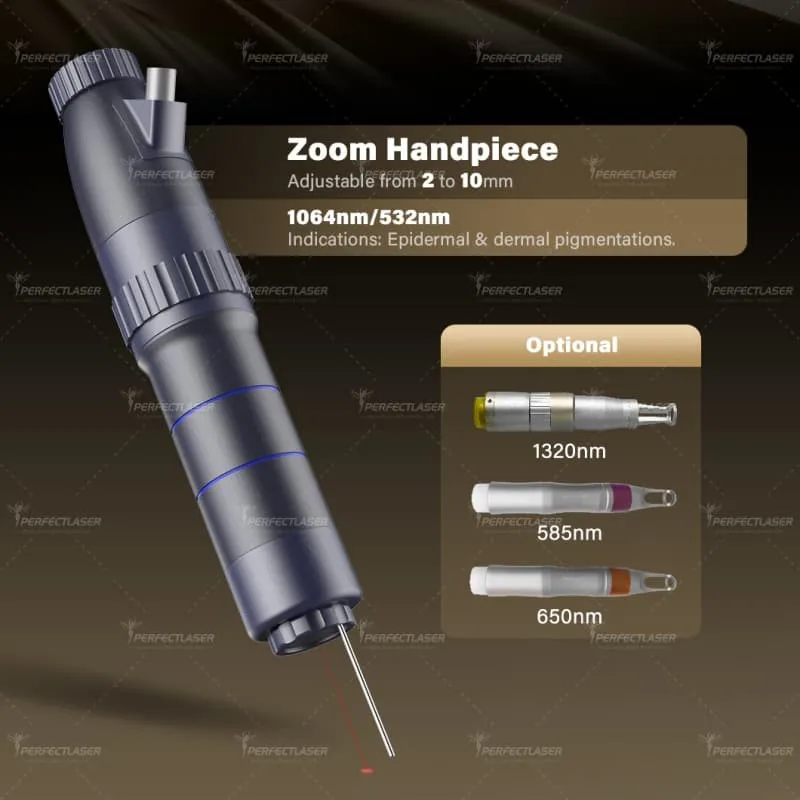
A professional system adds optional wavelengths: 585nm (yellow-green ink), 650nm (green and teal), and 1320nm (skin toning, carbon peel treatments). That last one opens carbon laser facial treatments as an additional revenue stream beyond tattoo removal — which matters for clinic ROI calculations. If you’re evaluating a Q switch laser tattoo removal machine for a clinic that sees a variety of tattoo colors, a multi-wavelength platform is not optional, it’s essential.
4. Cooling System: Triple Cooling Is the Standard for Clinical Use
Heat is the enemy of laser rod longevity and treatment consistency. Single-fan air cooling is adequate for sporadic home-use devices. For a clinic running 8–12 sessions per day, you need a triple-system approach: water cooling (primary thermal management for the laser cavity), air cooling (secondary airflow across electronics), and compressor cooling (active refrigeration that maintains stable operating temperature regardless of ambient room temperature).
The compressor is the piece that most buyers overlook. On hot summer days or in poorly ventilated treatment rooms, air-only systems will thermal-limit and reduce output automatically to protect the rod — which interrupts sessions and frustrates clients. A dedicated compressor refrigeration unit keeps the system at set temperature regardless of environment. For any Q switch laser tattoo removal machine running back-to-back clinical sessions, this is the cooling component that protects both the hardware and the consistency of each treatment pass.
5. Treatment Modes: 4 Modes vs. Single-Mode Systems
Modern Q switch laser tattoo removal machines offer multiple firing modes, each with a different clinical application. The four core modes worth understanding:
- Picosecond mode — ultra-short pulse duration for tattoo pigment and stubborn pigmentation; shatters ink into finer particles for faster clearance
- Long Pulse mode — 1064nm hair removal; converts the machine into a hair removal platform for added revenue
- PTP (Photo Thermal Pulse) — safer chloasma treatment; delivers energy in a controlled biphasic pattern that reduces thermal damage risk on melasma-prone skin
- Multi Pulse (Carbon Peel) — carbon laser facial for skin rejuvenation and deep pore clearing; high client demand in Asian market clinics
A machine with only one or two modes forces you to buy additional equipment for these indications. A four-mode system from a manufacturer like Perfectlaser covers tattoo removal, pigmentation, melasma, hair removal, and skin rejuvenation from a single platform — important when clinic floor space and capital budget are limited.
6. Light Guide Arm: Korean Import vs. Domestic
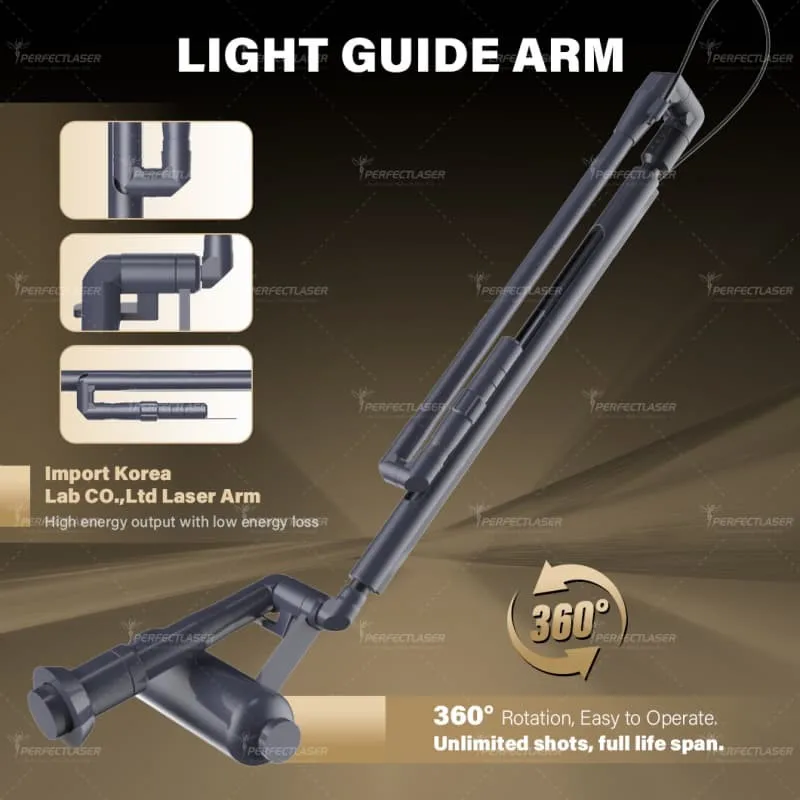
The articulated arm that delivers laser energy from the machine to the handpiece isn’t just a mechanical component — it’s a precision optical system. Energy loss through a low-quality arm means the energy you set on the screen isn’t the energy hitting the skin. Korean-manufactured laser arms (Lab CO.,Ltd is one of the recognized suppliers in the professional aesthetic laser industry) are engineered for high energy transmission with minimal internal reflection loss, and they’re rated for unlimited shots over the machine’s lifespan.
360° rotation is a practical clinical requirement, not a marketing feature. Treating the back, legs, or around contoured body areas requires full range of motion without cable strain or awkward repositioning. Budget arms with limited rotation fatigue faster and introduce energy inconsistency as the internal mirrors shift under mechanical stress.
7. Power Supply: Mean Well Medical-Grade vs. Generic Industrial
The power supply unit is what most buyers never think to ask about — and what causes the most expensive repair bills. A MEAN WELL medical-grade switching power supply from Taiwan maintains stable DC output under load fluctuations, protects against voltage spikes, and carries the certifications required for medical device classification in most markets.
Generic industrial power supplies can run fine for months, then fail catastrophically when hit with a voltage surge or extended high-duty-cycle operation. Replacing a burned-out generic PSU on a budget machine often costs as much as a substantial fraction of the machine’s original price — and during downtime, you’re losing booked sessions. A medical-grade supply is a long-term cost decision, not an unnecessary premium.
Complete Spec Reference Table
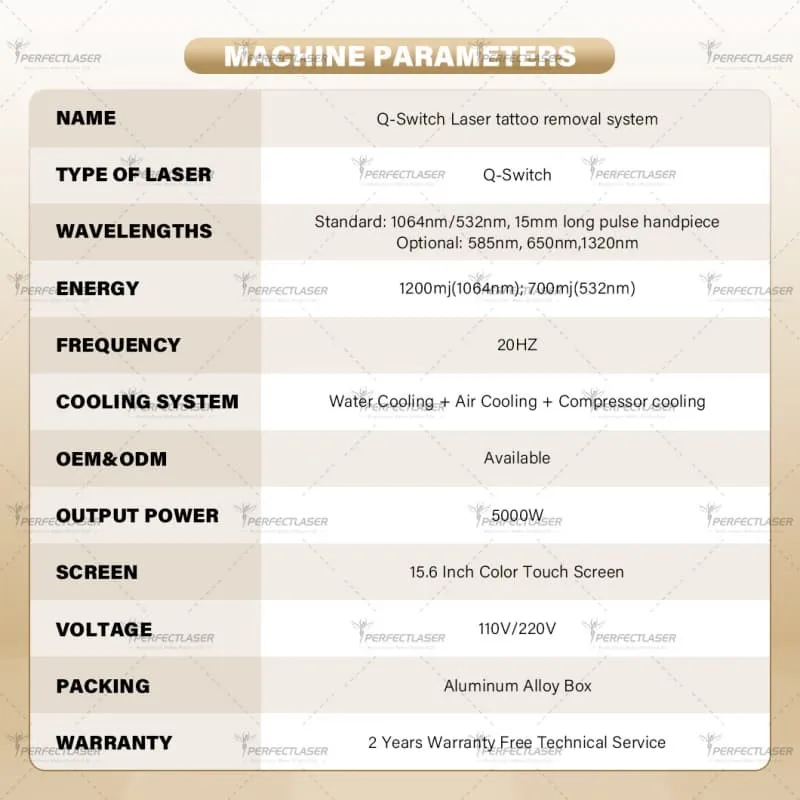
Use this table when comparing any Q switch laser tattoo removal machine against these benchmarks. Professional-grade specifications translate directly into clinical outcomes — session count, clearance quality, and machine uptime.
| Спецификация | Professional Grade | Entry Level |
|---|---|---|
| Laser source power | 2000 Вт | 500–800W |
| Laser rod configuration | Dual rod (φ7 + φ8mm) | Single rod |
| Max energy (1064nm) | 1200mJ | 400–600mJ |
| Частота | 20Hz sustained | 1–5Hz peak |
| Длины волн | 1064/532 + 585/650/1320nm | 1064/532nm only |
| Охлаждение | Water + Air + Compressor | Air only |
| Treatment modes | 4 (Pico/Long/PTP/Multi) | 1–2 |
| Laser arm | Korean import, 360° | Domestic, limited rotation |
| Power supply | Mean Well medical-grade | Generic industrial |
| Экран | 15.6″ HD touch | 7–10″ basic display |
Часто задаваемые вопросы
1. How many sessions does a Q switch laser tattoo removal machine typically need to clear a tattoo?
Most professional black tattoos require 6–10 sessions spaced 6–8 weeks apart. Colored tattoos, older tattoos with layered ink, or tattoos on thicker skin areas may need 10–15 sessions. A machine with higher energy output (1200mJ at 1064nm) and picosecond capability can reduce session count compared to older nanosecond-only systems by shattering ink into finer particles that the immune system clears faster.
2. What’s the difference between Q switch and пикосекундный лазер for tattoo removal?
Q switch lasers fire in nanosecond pulses (billionths of a second), which break ink through photothermal effect — heating and shattering particles. Picosecond lasers fire even shorter pulses that shatter ink more through photomechanical pressure, producing smaller fragments for faster immune clearance. Many professional systems now combine both modes in one machine, letting practitioners choose based on ink type and client skin response.
3. Can a Q switch laser tattoo removal machine treat all skin tones?
Yes, with appropriate parameter adjustments. The 1064nm wavelength has less melanin absorption than shorter wavelengths, making it safer for darker Fitzpatrick IV–VI skin tones. The 532nm wavelength carries higher risk of post-inflammatory hyperpigmentation on darker skin and should be used conservatively. A machine with adjustable spot size (2–10mm zoom handpiece) gives practitioners fine control over fluence at each skin type.
4. What maintenance does a professional Q switch laser require?
Key maintenance items: lamp replacement every 5–8 million shots (Heraeus lamps give longer, more predictable service life), water circuit inspection and distilled water replacement every 3–6 months, laser rod alignment check annually, and handpiece tip inspection before each session. Triple-cooling systems require periodic refrigerant level checks. Manufacturers like Перфектлазер typically include 2-year warranty and free technical service support.
5. Is a Q switch laser machine suitable for carbon laser facial treatments?
Yes — this is one of the best ROI additions for a clinic that already has a Q switch laser tattoo removal machine. The Multi Pulse (carbon peel) mode fires the 1064nm beam over a carbon lotion applied to the skin, vaporizing the carbon along with surface sebum, debris, and mild pigmentation. The treatment takes 20–30 minutes, requires no downtime, and is consistently popular with clients seeking skin brightening and pore minimization between deeper treatments.
 English
  Arabic
  Chinese
  Dutch
Dutch  French
  German
  Italian
  Portuguese
  Russian
  Spanish